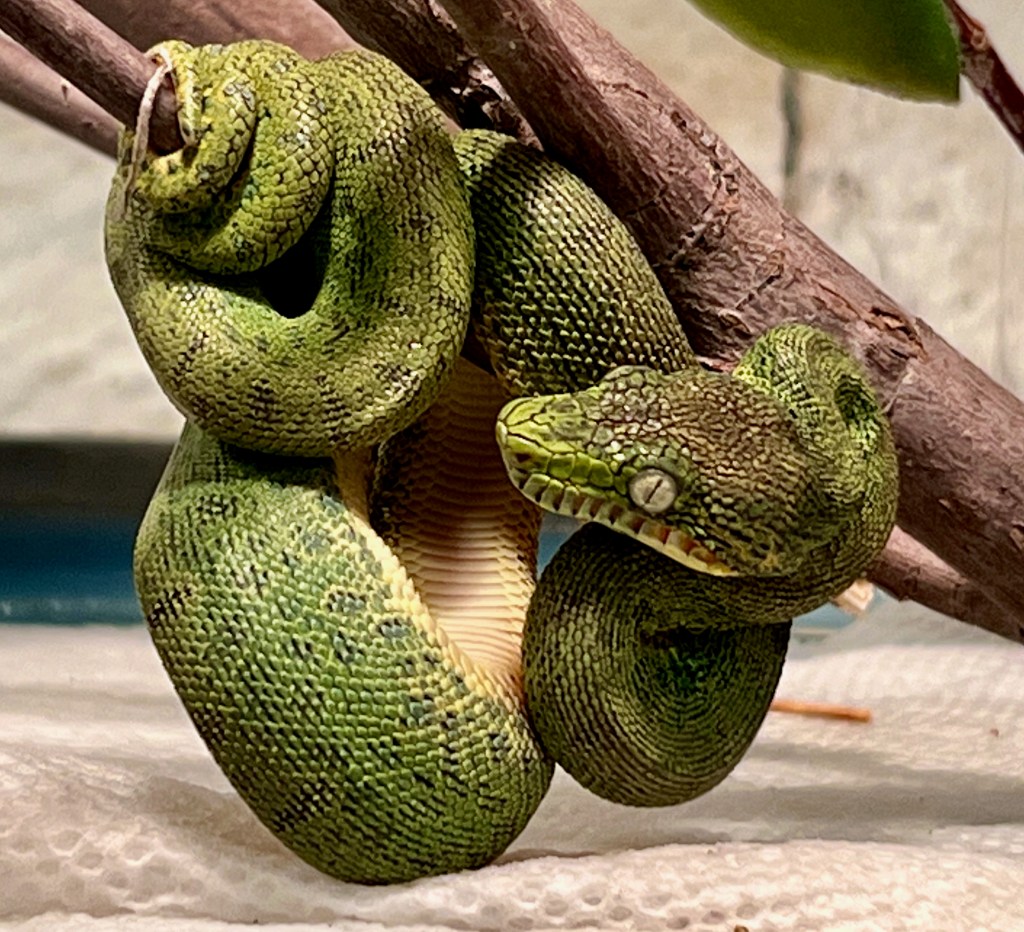
Debate continues around the humidity requirements of green pythons and emerald tree boas. In part, I think, because there are some misunderstandings about the role of humidity in the snakes’ physiological functioning and the various ways we keepers try to maintain proper levels.
When we have a snake that doesn’t shed well we tend to attribute that to humidity being too low. And keepers may be advised to increase humidity by adding a misting system, or shutting down ventilation. However, like all our herps, these species need fresh air, so closing ventilation isn’t a good idea. And misting systems tend to spike humidity levels and then, when turned off, allow levels to return to normal, low levels.
“Excessive humidity and temperature also promote fungal replication and sporula- tion so that exposure to fungal spores may reach a magnitude that will overcome the reptile’s immune system.” (1)
In fact, its questionable if high humidities are needed at all with these species. Keepers seem to think that because the snakes are from tropical environments, we need to recreate tropical humidities in our enclosures. The concern maybe that the snakes will dehydrate in lowr humidities. And by low humidity I mean 40-50%, not 10 or 20%
Dart frog and other frog keepers also assume this to be true, and as a result will soak their cages every day till the frog’s toes rot off and they die. Even after they see this happening they have trouble changing their ways. And even after I built vivariums that I only lightly misted every 7 or 10 days – which, by the way, more closely imitated the frogs wild habitat – the frog keepers refused to even consider it. Most got upset and yelled at me for even suggesting it.
So our herp myths run very deep! We must keep green pythons and tree boas at high humidities, or else! Or else what? A snake’s skin is almost completely impermeable to water. No water gets in or goes out through their skin. And of course they dont sweat. So why are we misting them? Why are we depriving them of something we know they need – fresh air – to ensure they get something we don’t know they need – high humidity.
There is no doubt that a snake will lose more water respiring in a dry environment than they would in a humid one. But how much? Keeping in mind how few breaths one of these snakes takes per minute, is it likely they would suffer any appreciable increase in water loss from 50% humidity to 80 or 90% humidity? And even if so, wouldn’t that loss be recovered just by drinking?
Like all animals, our snakes have to stay hydrated in order to maintain proper osmotic pressure in their bodies fluids. As they loss water and start to become dehydrated, their cells, kidneys and other organs lose their ability to function and toxins start to accumulate. And because its a potentially lethal condition, animals have developed a lot of different ways to minimize the likelihood of it occurring – mostly thru behavioral adaptations, and thru physiological adaptations.
This is an important point, because while some of the adaptations that allow the animals to deal with the stress of dehydration kick in quickly, others take time to develop.
So, that would mean misting may be doing more harm than good! If we mist the cage every day at noon, the snake may be in the process of adapting to the higher levels of humidity just as the humidity levels are plummeting back to their normal lows.
The question then becomes more about the range of humidities the snakes can easily adapt to. After all, why would a snake from the tropics develop water saving strategies? But in fact all animals seem to have the ability to take protective internal measures against dehydration.
Lizards, for example, can change the permeability of their skin in response to humidity changes, but it takes time – 24 hours in one study. Most frogs can resorb water from their urine and convert their waste to uric acid, thereby staving off dehydration.
But if any similar water saving processes are at work in our snakes, and they most certainly are, maybe we are short circuiting them by too quickly switching things up before they have a chance to adapt?
“A number of hormones function to control salt and ion regulation in amphibians and reptiles… many of these hormones are similar in all vertebrates. Certain hormones are rapidly released in response to an immediate threat, such as dehydration, whereas others are involved in long-term acclimation processes that ultimately reorganize cells and tissues and increase transport capacity. (1)
Maybe what we should be recommending is that we get the snakes established and settled in first. This means very well hydrated via rain system or heavy misting or a big bowl of fresh water – maybe with a gentle aerator in it. And then give them time to gradually adjust to the lower humidities of our temperate homes.
What we should avoid is jumping to conclusions based on those first couple weeks. Maybe we are too quick to blame the “overhead halogen” which is very beneficial to almost all herp species, when we see a rough shed. After all …
“The highly impermeable integument of reptiles permits direct exposure to sunlight without excessive water loss.” (2)
Often keepers are advised to mist more frequently when they see their snakes are ready to shed. But when we wet the snake’s skin by misting or spraying, the water softens the skin and causes it to more easily tear as the snake tries to shed. Instead of a nice clean shed, this can result in the same sort of mess we see when the snake tries to shed in an environment that’s too dry.
Moderation and time to adapt may be what we are missing.
Conclusions and Recommendations
Often snakes will choose security over preferred temperature. They may refuse to eat and presumably even drink when their access to prey or water requires them to compromise their perceived security. This is why larger, more environmentally stable enclosures that offer the snake a wide range of security gradients + temperature gradients + humidity gradients are best. Dont require that your snake abandon its “prime objective” which is security in order to feed or drink or find proper temperatures. The small, barren cubes we see popular in the hobby are a poor option for our captives.
The great thing about decreasing misting is that with less water being applied, we can use a deep substrate of quality potting mix, along with a layer of “forest litter” on top. And we want to do this because the slightly damp potting mix slowly releases water through evaporation, which provides a steady supply of moist air that will bring humidities up to that 40 or 50 or 60% level that we want even with good, offset ventilation.
A warm overhead halogen set up on a WiFi dimmer / timer is still the best option for heating. I dont doubt that animals have been overheated by these lamps, but thats a design flaw, nothing inherently bad about this helpful and important radiation. The enclosure should have a large number of *natural* branches that criss-cross the cage left and right and again top to bottom. The snakes should be able to find suitable temperatures and security in all parts of the cage. The 2 or 3 PVC “sticks” that cross the cube cages perfectly horizontally is not something we want for our snakes.
So there you have it. Instead of the sad small cube cages with PVC perches and baby diapers for substrate that we mist madly every day in a desperate attempt to keep the humidity up, lets try a different paradigm:
Larger, horizontal cages with deep, slightly damp potting mix substrate providing continual, gentle humidity that the animals can adapt to. Lots and lots of natural branches that criss-cross the cage. Fake or real plants that provide overhanging security and protection over some, but not all of those branches. Bowls of *fresh* water, possibly initially with a gentle aerator air stone to cause movement and attract the snakes attention. And then TIME. Time to watch and learn, time for the snake to adapt to its new environment, and time for you to figure out what you need to change to provide them with what they need.
- Infectious Diseases and Pathology of Reptiles. Jacobsen, 2007 p. 548
- Herpetology: An Introductory Biology of Amphibians and Reptiles 4th. Vitt and Caldwell, 2014 p. 168
- Ibid p. 208
Further Reading
Tu MC, Lillywhite HB, Menon JG, and Menon GK. 2002. Postnatal ecdysis establishes the permeability barrier in snake skin: new insights into barrier lipid structures. J Exp Biol 205: 3019–3030.
PARATHYROID GLANDS, VITAMIN D3, AND CALCIUM HOMEOSTASIS: Mader’s Reptile and Amphibian Medicine and Surgery. Divers and Stahl. p. 987
Agugliaro J, Reinert HK. Comparative skin permeability of neonatal and adult timber rattlesnakes (Crotalus horridus). Comp Biochem Physiol A Mol Integr Physiol. 2005;141(1):70–75.
 Herpetoculture Inc
Leave a comment