A Nearly Perfect Snake Cage for Nearly No Money

You need very little of what is often suggested “`

This Guide will walk you thru the simple steps needed to create a nearly perfect snake cage – and explain why it is, in fact, nearly perfect! PLUS – you will have basically no maintenance of this cage. The waste produced will quickly cycle, just as it does in an aquarium full of fish.

What makes a great cage? If you believe much of whats out their online you would think it takes a lot of planning and money to create the best possible snake cage. The fact is none of that technology is needed, and much of it causes more problems than it helps.

Remember that the advice you see and read online is almost always offered by people trying to sell things. If not selling actual products, then they are selling their sponsors’ products, or selling themselves. Your animals are far from their priority!

I recently watched a YT video that featured a number of industry “experts” in a real time cage design competition. It was immediately apparent that the contestants had given zero consideration to the animal’s actual needs, but were simply pushing product – and themselves. A shameless self promotion masquerading as helpful guidance for the new keeper. Yuck.

When we think of good cage design we want to think about nature, and the micro-habitat that our species occupies within the broader ecosystem. Our animals have evolved over millions of years to exist in a specific environment. But so much of the current cage design paradigm we see doesn’t even acknowledge that environment.

Imagine for just a second that you are a rat snake, garter snake, hog-nose snake or other commonly kept species living in the wild. At the break of dawn on a spring day the temperature may be in the mid-60s, a heavy dew may lie on the grass, and the humidity is high. Its cool and damp in your world, and you’ve spent the night under a slab of bark, or a flat stone, secure and calm.

As the sun comes up on this spring morning you emerge from your cover and bask in the warm sunshine. As your body comes up to full operating temperature you begin your search for food. If you are lucky, you’ll track down a tree frog, a fence lizard or even a nest of baby mice.

After feeding you need warmth and security. You find a rock pile warmed by the sun, or curl up under dried grasses along the forest edge to digest your meal. It is warm and dry all through the day. The warmth lingers in the rocks or under the grasses, allowing you to stay warmer than the surrounding air well into the night.

In this simple scenario we see a wide range of temperatures and humidities in the course of just one day. We see the snake has adapted her behavior to the wide ranging conditions too. We see radiation in the form of UV and (more important in the snake’s case) near infra-red.

The snake has access to 90% humidity under the rocks, 60% humidity under the grasses or leaves, or 30% humidity basking in the sun – all within a few feet of each other!

The snake has an equally big thermal gradient. From the mid-60s under the stones, to the 70s and 80s under the leaves or grasses, all the way thru the 90s basking in the sun.

In order to provide care that responds to our snake’s needs we need to provide these big gradients. They are adapted to the conditions and they know how to take advantage of them. Full of food they will select the warm, dry areas. Getting ready to shed they may spend days under cover, safe and secure in a high humid environment.

So how do we manage all these variables in a small enclosure? Thankfully it is neither complicated nor expensive. The entire set up takes only a few minutes once you have gathered the materials!
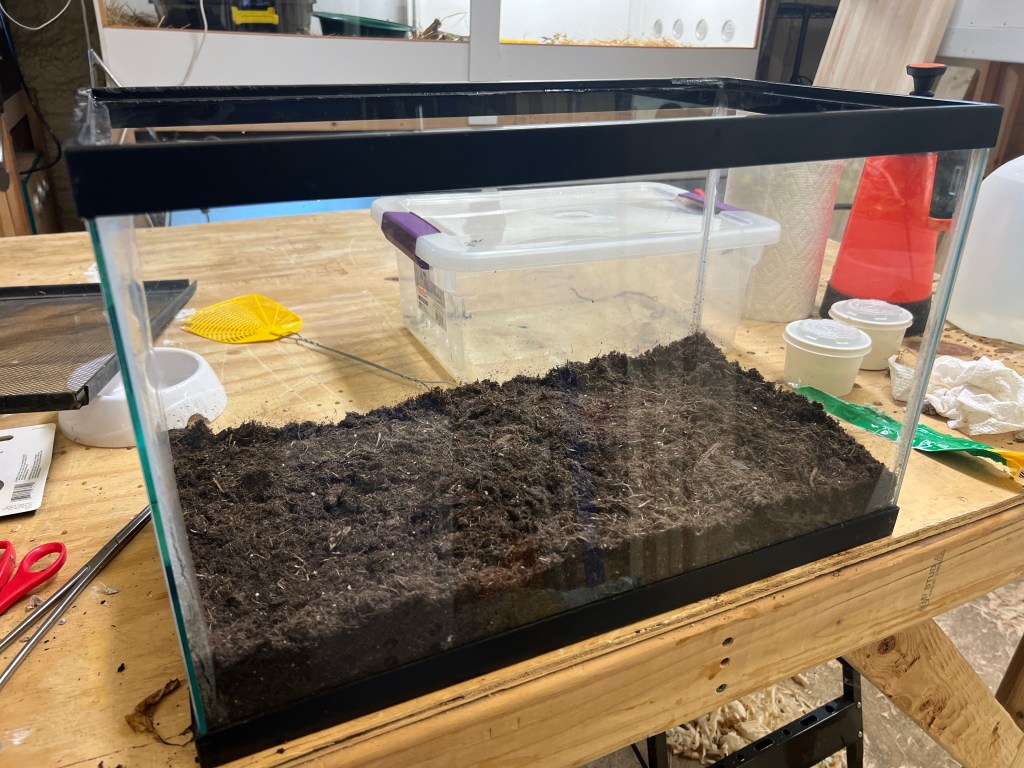
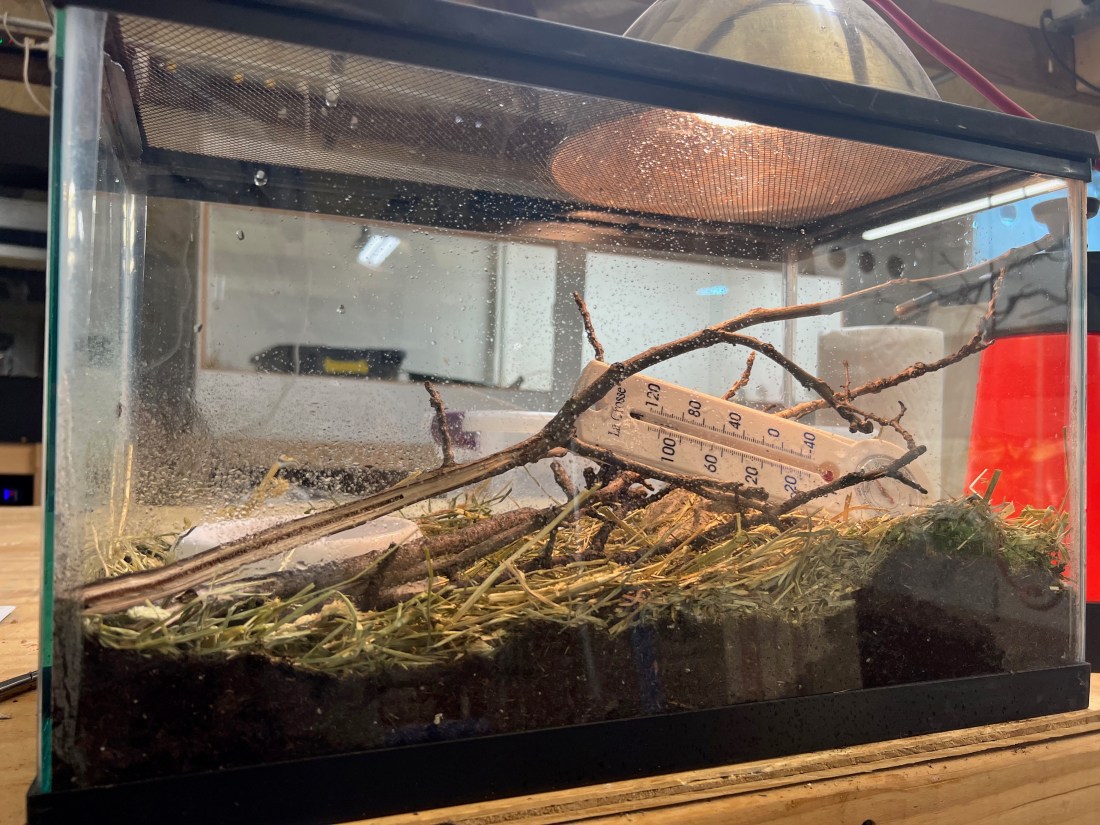
Believe it or not, one of the best choices for a snake cage is a glass tank. People get confused about this for a couple of reasons. Some suggest the clear glass makes the animals nervous. This is not often the case, but can be remedied by taping paper or some other cover on the back and sides.

Others suggest the glass transmits too much heat. But the more heat that is lost thru the cage walls the better! We are not baking cookies! This is not an oven. The temperature gradients we want to create depend on heat being quickly dissipated, which is why the screen top is so perfect – we *want* the heat to rapidly escape thru the top of the cage.

One of the biggest design flaws in commercial cages is bad ventilation. Often they have vents clustered up at the top sides or the back with no option for the inflow of cooler, fresh air. This is a *critical flaw* and is one of the reasons I have never purchased a commercial cage and never will.

Substrate

So with our basic tank set up, we add a deep layer of a good quality potting mix. I use Miracle-gro because in my experience it offers the most consistent high quality. Potting MIX is key here. DO NOT use top soil which can contain pathogens and is NOT suited for containers like our vivariums. It actually states this on most packages. Do not buy top soil, or garden soil, or raised bed soil and then amend it with other stuff. If you created the most perfect ABG (Atlanta Botanical Garden) mix it would be no better, and probably much worse than quality potting mix.

Do not buy substrate from the online sites or herp shows or pet stores. Ive tested these products and they range from terrible to passable. But none are as good as potting mix. (Note that potting mix can be mixed with up to 50% *coarse* sand, not fine, or play box sand. You want drainage and the coarse sand will drain much better than the fine sand.

Do NOT add a drainage layer! No bigger wrong headed, waste of money has ever been invented.
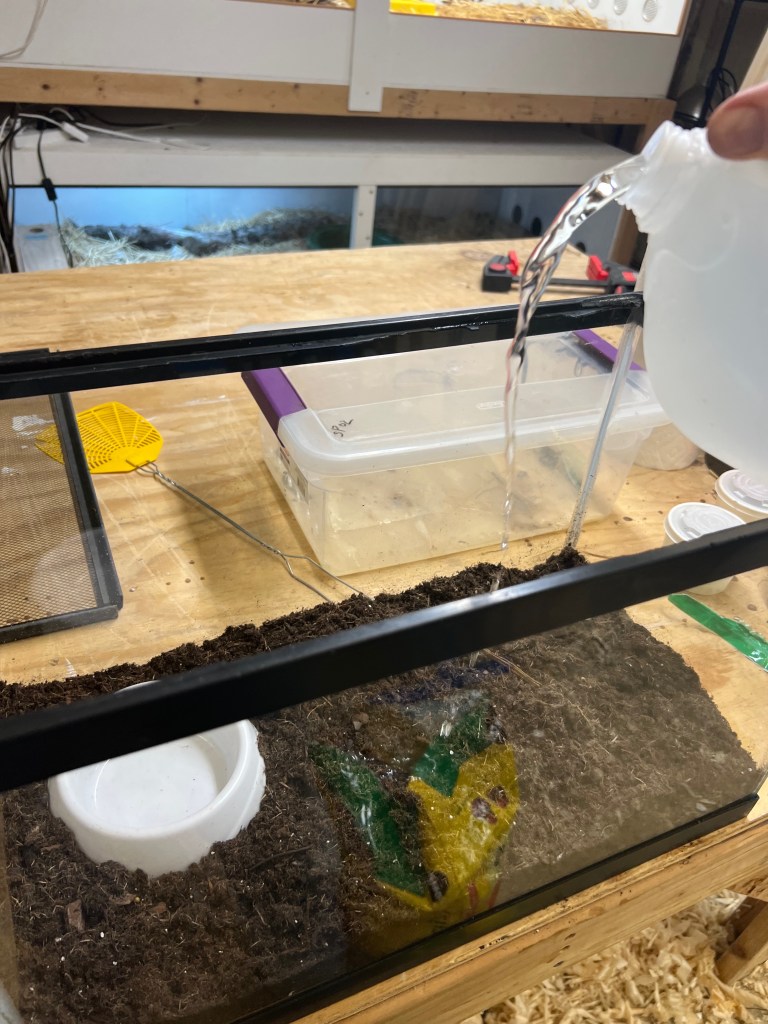
The only learning curve to this set up is managing substrate water content. The substrate needs to be wet well, then allowed to dry down to nearly dry. The lowest layer of the potting mix will tell you when to add more water. And when you do add water, add plenty. For example a 20 gallon long aquarium with 3-4 inches of potting mix may need 3 gallons of water poured in every 3-4 weeks.
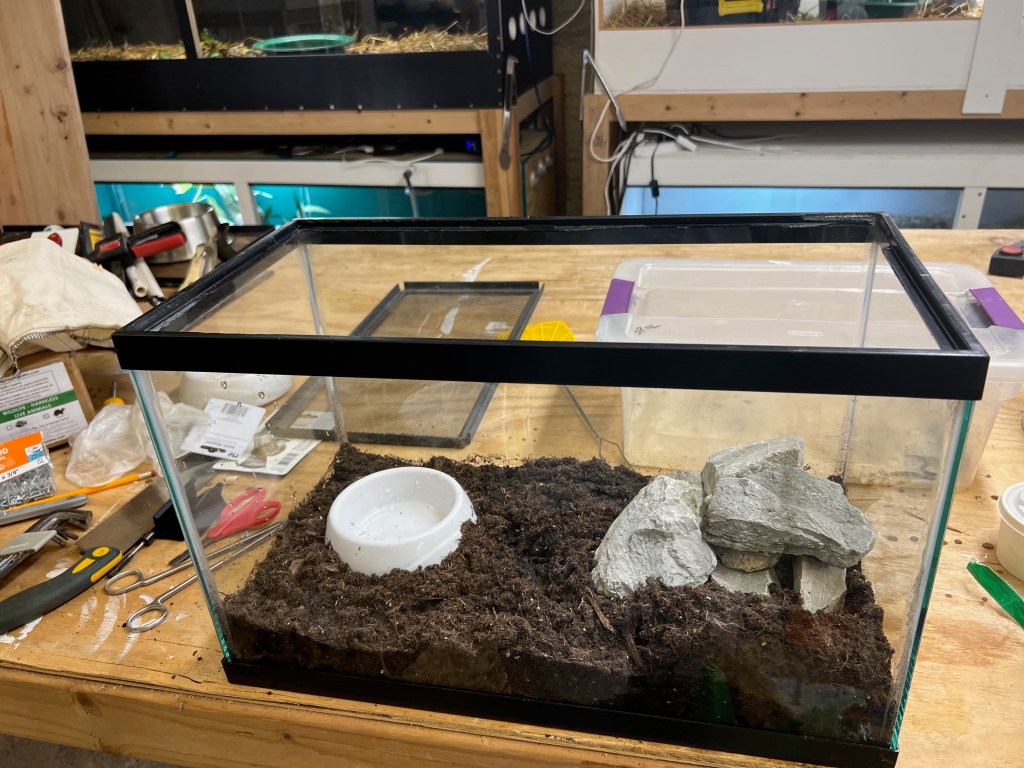
Rocks

Rocks are not required but provide many benefits. Snakes love rocks. They seem to understand they are safe in a rock pile. In nature we often find snakes in and around rock piles.

Rocks absorb heat from our overhead lamp and dissipate it when the lamp is turned off. This provides a gentle heat gradient even after lights out. As important, rocks provide the rough, solid surface snakes need to shed. A smooth sided cage can seriously injure a snake as it pushes hard trying to start a shed.

The most important thing about rocks is that they have to be set directly on the cage floor, and set their securely. Otherwise a snake may burrow under a rocks and have it collapse on top of them. Wedge them in good so the snake cant disrupt them.
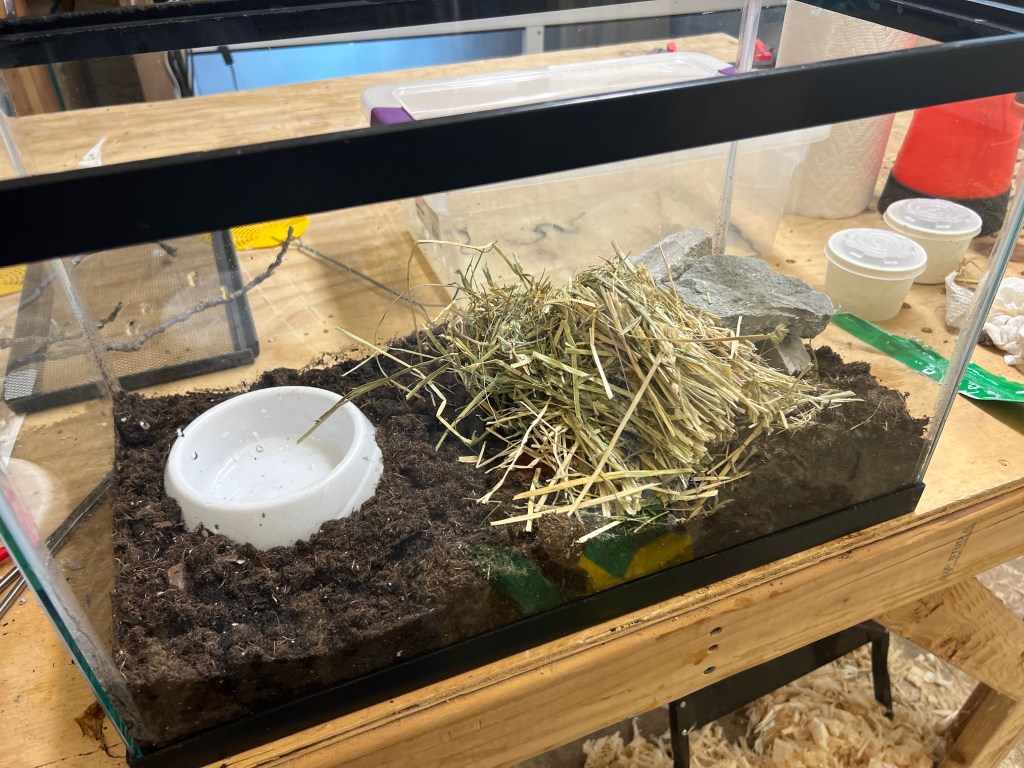
Forest Litter

Some sort of forest litter is also critical. It seems simple but it plays a huge role in the creation of the environmental parameters in our vivariums. I use dried leaves (collected from a nearby state park as soon as they fall so they don’t collect bugs and mold), or hay or straw from the farm store, or even dried grass from the mower.

The reason this forest litter layer is so important is because it creates an all important humidity gradient by trapping the moisture evaporating from the potting mix. Humidity under the litter can be 80 or 90% while humidity a few inches away under the basking light can be 40% or even less.

The other reason this layer is important is because it allows the snake to thermoregulate without being exposed. Admittedly this is more important for some snakes than others, but for many species – especially when young – it is very important.

A snake has to thermoregulate to be healthy. They have to be able to choose appropriate temperatures for digestion, shedding, metabolism and reproduction. The old 2-hide system with one hide on each end is a bad substitute. With this layer of forest litter the snake can micr0-manage it’s body temps and its humidity very similar to how it would in nature.
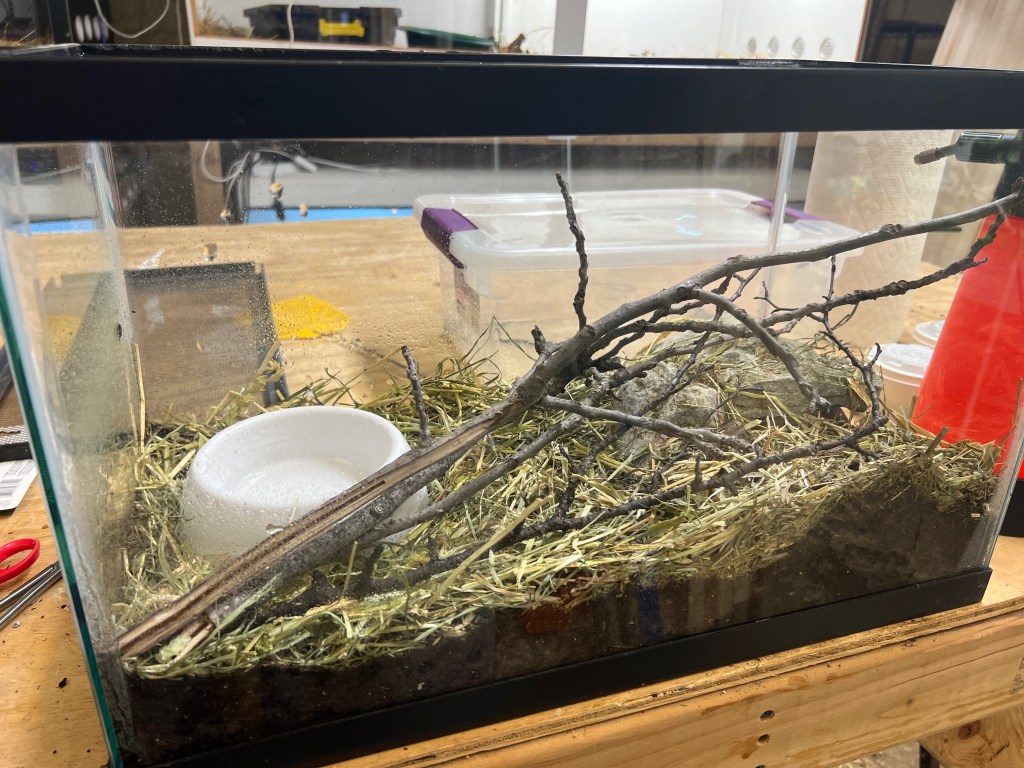
Climbing Branches

In captivity even thoroughly terrestrial snakes will climb. Partially just trying to escape, but branches offer a third detention to their thermoregulation. They also offer the snake more shedding assistance, and this can be important depending on species your keeping.
Screen Top w/ Clamps

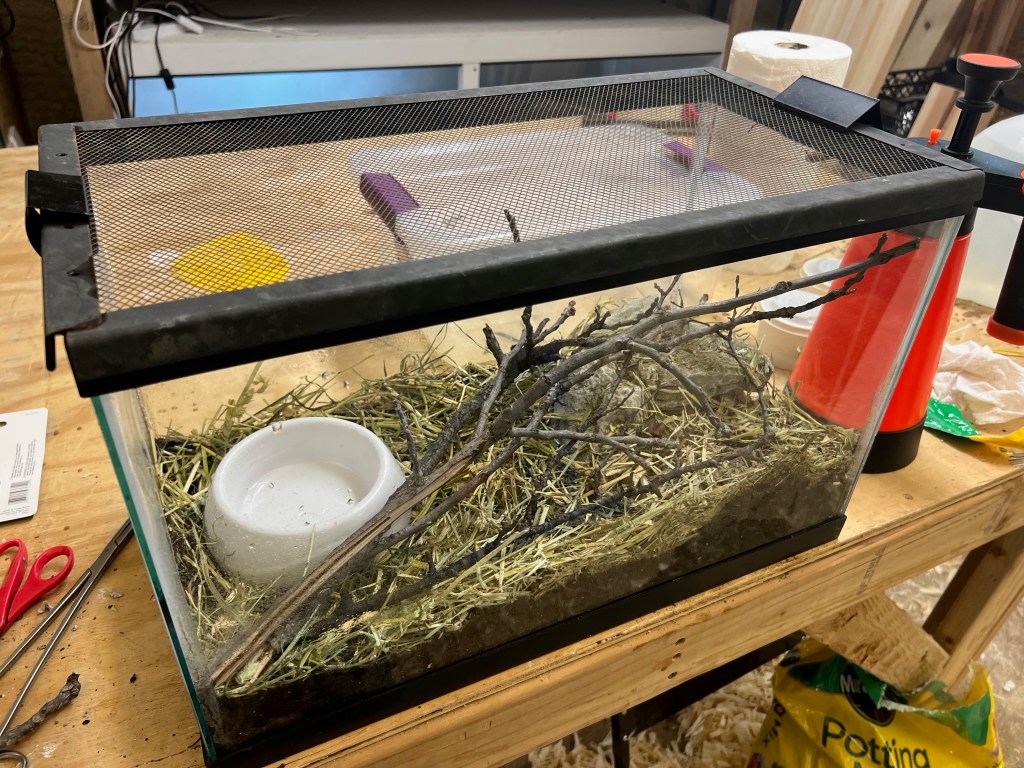
Screen tops are erfect for snakes because they provide the temp gradients and the fresh air all herps need. Note you will not need to cover the top even partially to increase humidity. Remember our potting mix substrate will be providing the humidity – and will be doing it in a natural way that the snake is adapted to. In nature when snakes need higher humidity the go to the forest litter, under surface cover like rocks, logs and leaves.

Clamps! I’m embarssed to say that I have on more than one occasion walked away from a snake cage secure in my belief that the occupant can in no way get out of its tank, only to find later that it has! These clamps are a PIA and I wish some innovative changes would be made to them, but they are a lot less of a hassle than searching for a lost snake. And to be honest, they are a lot less hassle than the stack of books or bricks we used to routinely use to keep lids tight.
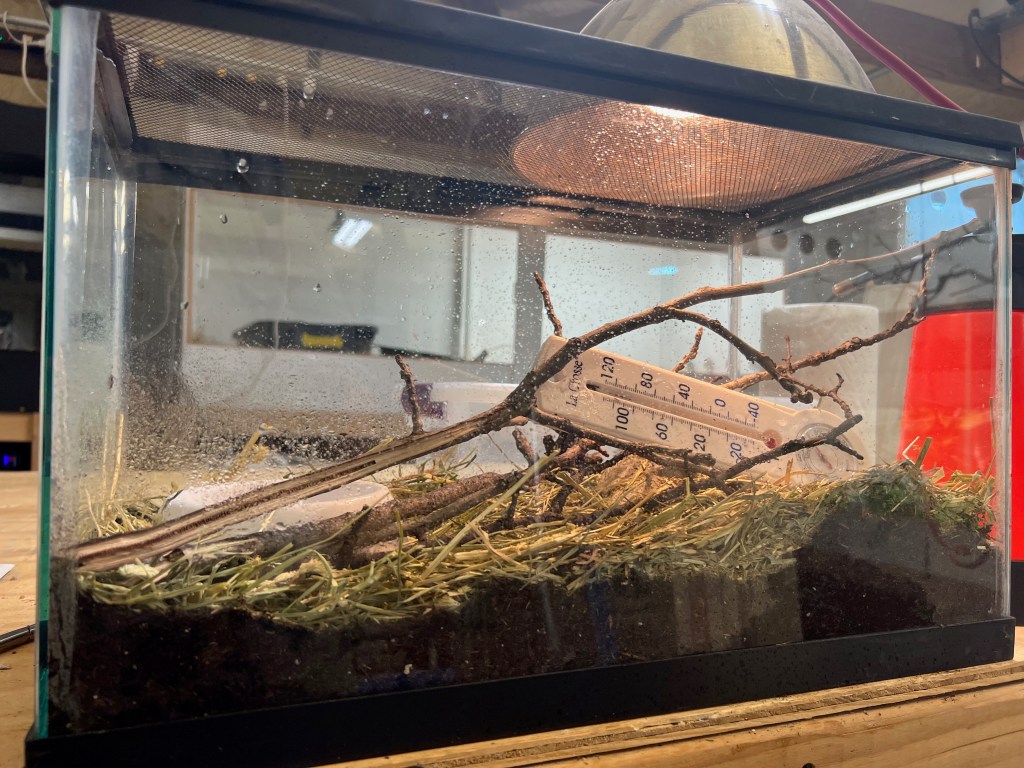
Another critical element of good cage design is over head incandescent / halogen lamp. Not ceramic heat emitters (their heat does not radiate down, it floats up!), and not radiant heat panels (they have the same problem).

Incandescent bulbs produce the same warming radiation that the sun does. It penetrates the snake’s skin and is distributed thru they animal via its circulatory system. The radiation from ceramics and RHPs does not penetrate the snake’s skin. It is an un-natural, and unhealthy way to provide anything other than background or ambient heating.

Not that you dont have to buy the expensive bulbs and reflectors sold at pet stores. These better quality reflectors are sold for raising chicks at the farm stores. You might even try buying the 150 watt heat bulbs sold there – but make sure you have a dimmer to dial them back.

Notice there is also no reason to (almost) ever buy a thermostat. The $3.00 thermometer un the photo is more than adequate to establish the right warm side temperatures. Wireless dimmer / timers can be bought now for not much money, and they are a much better investment than the thermostats.

Here is a link to the digital dimmer / timer:
https://www.amazon.com/dp/B0BXP8QL52
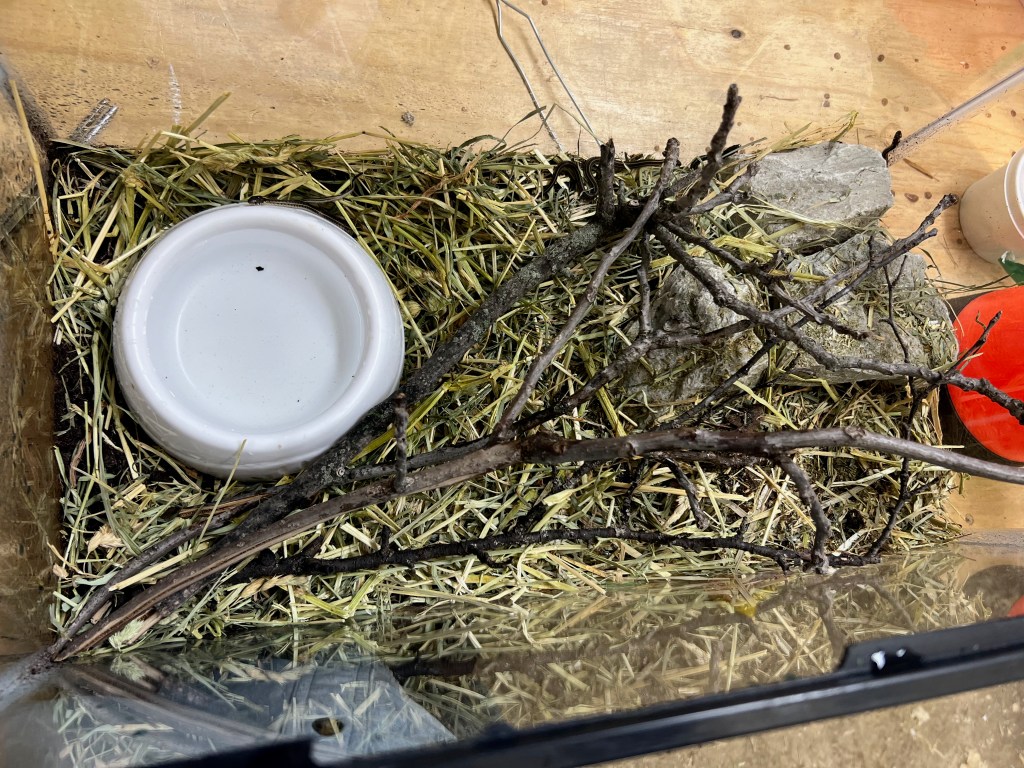
So here is a look at your tank all set up. Notice the snakes can hide under the water bowl at the cool end. Humidity under the bowl will stay quite high – easily 80%. The temps will go up and the humidity will go down as the snake moves from the cool water bowl to the warm rocks. And it can find both security and perfect environmental parameters under the forest litter anywhere in between.

The branches rise up closer to the warm light, so add even warmer options for the snake.
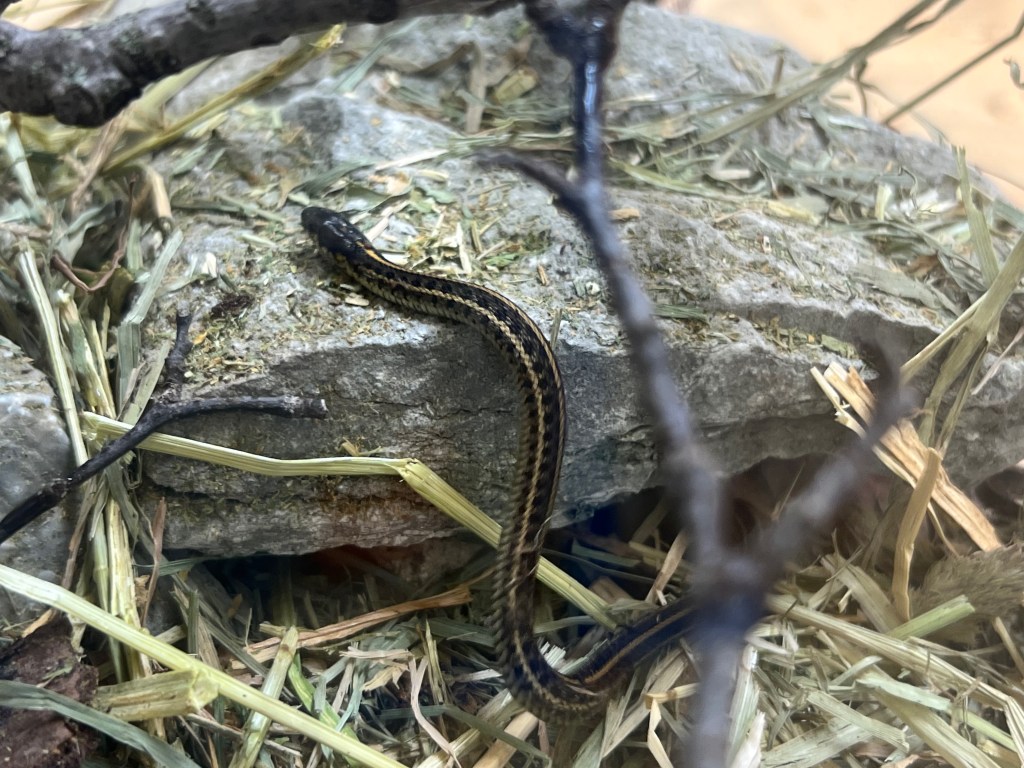
All that is left to do is add your snake(s) and start your observations. You will want to watch and learn from your animals now. where do they hang out in the vivarium? Where do they avoid? Double check your temperatures and your moisture levels.

In a well designed anclosure like this there will be times when you wont see your pet. This is a good thing. It means she is happily snug down in the substrate, not stressed out, crawling around searching for better conditions. After the snake feeds it may disappear into the rocks to digest for a few days. When it enters a shed cycle it will certainly head into the cool, humid substrate to properly prepare for shedding.

And when it sheds, it will be a perfect or nearly perfect shed! A good sign that you have done everything right!
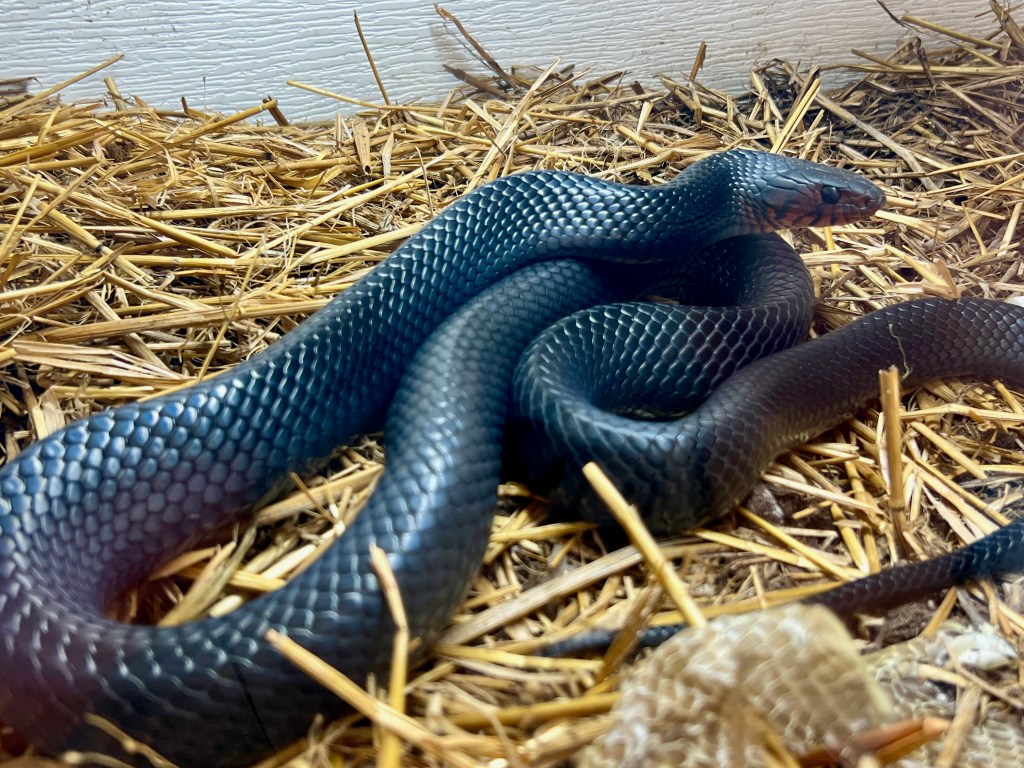
And here is some good news. Once you get these design parameters down, you will know how to make great cages for many species of many sizes – from baby garter snakes to big indigo snakes, and many in between.

And here is the amazing thing. You can design and build this enclosure for a tiny fraction of the cost of the poorly designed cages we so often see online. There is simply no need for the expensive bits and pieces that are often suggested by those who make money from their sale. There is nothing you could buy at a pet store or online that would make this design better for your animals, although obviously you can add whatever aesthetic elements you want, as long as you dont alter the environmental parameters provided by this basic design.

The “Diverse Diet” Myth

The pursuit of diversity in our pets diet may be doing more harm than good!

I decided to write about this topic of diverse (or varied) diets for reptiles – primarily snakes – because of the increasing number of posts I was reading from keepers concerned that their herp pets were not getting a sufficiently diverse diet. Many were trying to diversify their pet’s diet by adding things like chicken hearts and necks, tilapia or salmon fillets, whole (eviscerated) fish, frog legs and more. Some were actually collecting road kill!


I suspected, and then confirmed, that the impetus for this new trend came from some popular care sheet sights, and popular Facebook groups that are known to promote the highest possible care for our reptile and amphibian pets. They have a deserved reputation for good advice, so they deserve the respect they get. The problems come from well intentioned keepers who misinterpret the advice, or dont have the experience to keep it in perspective. 


These newbies often adopt an almost religious zeal for their new faith in proper animal care. They can become quite fanatical about it! Before long the sound advice offered by the more experienced practitioners is warped into Holy Commandments that separate the devout from the heretics. And thats not helpful.


First, let me emphasize that there is nothing wrong with feeding a variety of prey items that reflect the species natural diet. In fact, this is the ideal. Unfortunately its also nearly impossible. Unless we feed wild prey collected from the same range and habitat that the species evolved in, we are not duplicating the nutrient mix it has evolved to utilize. Feeding frozen frog meat raised in crowded tanks and fed an artificial diet half a world away to a snake that would normally be feeding on whole, live leopard frogs in a US swamp with its belly full of June bugs is not the same thing. Yes they are both frogs, no the nutrition they offer is not even similar.


So the problem isnt that we want to feed a diverse diet to our animals. The problem is that trying to do so we can mess up in a way that is harmful to our animals. And importantly – it is often simply not necessary to pursue this goal of dietary diversity – at least not for most species, most of the time. Providing whole prey that is our domestic corollary to the animals natural wild prey, providing supplemental nutrients were necessary (dusting crickets, for example) is what our goal should be. Not diversity for diversities sake.


We human beings are frequently advised to eat a varied diet. We are told to eat a variety of grains and vegetables every day, etc. And I think we sort of internalize that advice and then extrapolate it to our animals. This is probably part of the motivation for the boom in diverse dog and cat foods. These too promised better nutrition and higher care but many turned out to  be harmful, and the “grain-free” craze even led to a number of dogs’ deaths. 


So what is important is that we not let the “idea” of feeding a diverse diet get in the way of understanding and providing good nutrition. And this is exactly whats happening. In pursuit of diversity some of us are providing lower quality diets that may not meet our animal’s nutritional needs, or may be exposing them to unnecessary risks.


I’ll try to explain with some examples. If you are raising a young garter snake on a diet of chopped worms and pink mice it is getting a “complete” and balanced diet. But lets say in the pursuit of a more varied diet you start offering bits of tilapia or salmon. Of course the garter (or hognose, or king snake, etc) may well eat the salmon, since all these species are eager feeders. But what you have done is replaced a nutritionally balanced meal with a nutritional deficient meal. You have increased variety but decreased nutrition.


This wont be a big deal if it happens a couple times per month. But feeding fish fillets is also easier, cheaper and less messy than feeding chopped worms and thawed pinks. And so it can easily become more than once a month. It can become the norm. And consider that the vast majority of wild garter snakes, let alone hog nose snakes, king snakes and rat snakes, will never eat a fish, why are we feeding fish to our captive snakes? Because it provides diversity?


The addition of these artificial food items also introduce risk. Almost all are treated with preservatives including carbon monoxide (illegal in most countries other than the US), and many are brined in salt water. Chickens are vaccinated and medicated. Why introduce those potential risks to our pets?


This is an important point: We know that well raised domestic mice *provide all the nutrition a snake needs to be perfectly healthy*. We know that from research that has examined the nutritional profile of domestic mice, and we know that because we have a few million captive snakes that have been raised on a diet of domestic mice and that displayed no disorders or diseases attributable to their diet. Note that the nutritional completeness depends on what the animal is fed. (1) So always source your herps’ food from the highest quality producers, not your neighbor kid feeding his mice collection cat or dog food.


“Although whole prey, including their organs, should be a *complete nutrient sufficient feed*, it is advised to add a small amount of a balanced vitamin and mineral supplement, especially when the birds are under stress.” (1) (More about supplements below)


“Mice and rats raised in captivity are usually considered to be a good quality food source. .. Feeding reptiles young lean mice that have been fed a high-quality, plant-based rodent chow provides a healthier diet…multivitamin and mineral supplementation for rodent feeders is usually not considered necessary, because properly fed rodents represent a complete diet (entire rodent ingested). In fact, one study showed no significant difference in size, weight, or bone density in two groups of hatchling corn snakes fed supplemented and nonsupplemented mice (Backner B, personal communication, 1991). “
Mader’s REPTILE AND AMPHIBIAN Medicine and Surgery P 174


Another quick example. People will often offer their snakes fish in various forms – again something the snakes would not be eating in nature. For no nutritional reason, they will, for example, feed their indigo snake trout from the fresh fish market, or feed their garter snake frozen silversides. In the interest of a diverse diet of course. These un-natural prey items cause gastro-intestinal problems that result in smelly, watery feces that we often hear keepers complain about. Why are we doing that? Well if you ask keepers, they will often tell you its because variety in the snakes diet is “important”. But variety, for it’s own sake, is not important and may in fact be harmful.


I want to touch on another issue that often comes up around this topic. And that is the claim that mice are “fatty” and therefore cause obesity in snakes. There are two important points to understand about this concern. The first is that adult mice are not significantly different than other often fed prey. Adult mice are 23% fat content, adult rats are 32% fat and adult quail are 32%. Day old chicks are 22% fat but add fat quickly and reach 38% by adulthood. Any animal that feeds on whole prey is going to be adapted to a high fat diet, so the fat content of these prey items should not be a problem for rodent eating snakes. For others, like garter snakes or water snakes, the rodents offered should be part of a diet that includes those species natural prey: whole fish, whole frogs and for garter snakes, worms. If you are feeding pieces of fish or frog legs simply because the whole animals are not available, then the keeper should carefully consider the addition of supplements.


No snakes should be allowed to become fat in our care. Fat snakes are overfed snakes. The easiest way to correct the problem is simply to reduce the amount of food that is fed. Some species are very enthusiastic feeders and will always seem to be hungry. That doesnt mean we need to feed it.


It is instructive to take a quick look at the natural diets of snakes. Reptiles and amphibians in general, and snakes in particular have a relatively limited range of foods they consume in nature. Even generalist species that may at times take a wider variety of prey tend to derive the majority of their nutrition from a relatively small number of prey species. Gopher snakes may eat almost exclusively small mammals for example. Hognose snakes may eat frogs and toads and small mammals. Garter snakes in the east of the US will live out their lives eating mostly frogs, toads and worms. This is of course a fraction of the number of species that a mammalian omnivore would consume. So our understanding of what diverse means should be relative to the animals natural diet, and not the diet of a mammalian omnivore.


Some species of snake have extremely restricted diets. How do snail eating snakes survive on just snails? Or even more remarkable, egg-eating snakes on just eggs? These snake species are able to derive sufficient nutrition to meet all their own physiological needs and produce young, yet consume only a single type of food their entire lives. Of course this isnt evidence for limiting our pet’s diet. Different species have the ability to extract different nutrients from their food. But this ability is something that has evolved over time and depends on the animal’s natural prey. (3) It is important to keep this in mind when we hear claims that a diverse diet is so important to our snakes! 


Supplements are a consideration too. Its possible to do damage with supplements. Some natural prey has very high concentrations of vitamins – adult mice may have over 500,000 IU/kg of vitamin A, for example. And there is an upper safe limit to the amount of vitamin A we should be offering our animals. Not to mention that many of us are guilty of not being all that careful when using supplements. I know many of us couldn’t say how much we are adding or even why. We assume – wrongly – that the supplements are safe and effective regardless of dosage.


That said, the diets we feed our animals certainly are not what they have evolved to consume. The stomach contents of wild animals provide nutrients in quantities our captive prey items won’t – some more, some less. And of course in some cases – like to balance the unbalanced nutrients in crickets – we need supplements to just make sure the diet sufficient for normal bodily functions. So while its true that our animals generally dont need supplements, its also true that there may be benefits in some cases. The careful use of calcium, vitamin D, other vitamins and minerals from a high quality source is not something I would argue against. 


The subject of diet in relation to enrichment has come up a few times. My initial reaction was that it was not a serious consideration. But I realized that that may be true more for snakes than for other herp species. Some lizard and tortoise species may be more stimulated by different foods than most snakes are, for example. So Ive decided to leave this area to the reader to experiment with and work out for themselves with their own animals. Keeping in mind of course the one big caveat I hope to communicate here: Nutritional needs should drive our animal’s diet, not the pursuit of some fictional good called diversity.


1. https://www.merckvetmanual.com/management-and-nutrition/nutrition-exotic-and-zoo-animals/nutrition-in-raptors#:~:text=Commonly%20fed%20items%20include%20mice,bred%20prey%20should%20be%20fed.
2. http://www.nal.usda.gov/awic/zoo/WholePreyFinal02May29.pdf
3. https://sora.unm.edu/sites/default/files/journals/jrr/v031n03/p00267-p00272.pdf

Wild Caught, Big Breeder, Pet Store and Imported Herps?

Is it Ethical to Buy Wild Caught or Imported Reptiles and Amphibians? —

Catching Wild Reptiles and Amphibians

I think its great that there seems to be a trend towards greater compassion for animals. Humans have historically treated animals horribly, maybe especially reptiles and amphibians. I cant stand the fact that it’s legal for fishermen to pierce the heads of live frogs and salamanders with fish hooks to use for bait. And of course the epic cruelty that snakes the world over experience seems like it will never stop.

But I think sometimes our laudable increasing awareness of animal mistreatment gets a little off track.

There are three issues to think about. The first is the natural history and ecology of the wild caught animal. The second is the trade in wild caught and imported herps and the third is comparing those two things to the captive herp production industry.

A basic tenant of ecology is the fact that all animals produce an excess of offspring. The offspring vary genetically and that genetic variation means some are better suited to the changing environment and some are less suited. The less suited tend to die, the stronger survive. Thats evolution in a nutshell!

Let’s take a common snapping turtle (Chelydra serpentina) as an example. A female snapping turtle that hatched toward the end of WWII (1945) would reach sexual maturity and start laying eggs in about 1960. And lets say she averaged 30 eggs each year until last year when she died during hibernation. That means she had a reproductive life of about 62 years and laid a total of 1860 eggs during her life time!

Whats going to happen to all those babies? If they all live, they will all die. Why? Because their environment wont be able to support those numbers of turtles. So they will consume the available food and starve, or be so crowded that disease will spread quickly and do them in.

And that’s why it is not harmful to remove some of the more common species from stable populations. In fact it it has been shown that in some cases a sustainable harvest actually benefits the population as a whole. (This is the case with sport hunting and even trapping, as cruel as that is).

I often read a post on social media where someone indicates they removed a reptile or amphibian from the wild to keep as a pet. The post invariably has a whole slew of comments along the lines of “Let it go”, or “It belongs in nature”. And I love that show of respect for the animal. But the truth is being captured and brought home to an informed and respectful keeper’s home is probably the best thing that will ever happen to that snake, frog, lizard or salamander. Life in the wild is usually “nasty, brutish and short” whether we like it or not. And removing one individual animal from a stable population will do no harm to the ecosystem.

That leads us to an important caveat: If the captor doesn’t know the details of the animal’s population in the area, and the legality of taking it, it would not be ethical (or legal) for them to do so. And if they did not know, or be willing to quickly learn, the proper way to keep the species in captivity it would not be ethical for them to remove it from the wild.

Most of the most ardent herpers that are my age grew up catching our pet herps. I’m sure none of us did any permanent damage to these species. And Im equally sure many of us developed a deep understanding, respect and passion for the animals we chased through marshes, woodlands and across rocky deserts.

In fact, one of the biggest problems I see in the herp hobby today is people trying to care for these animals who know nothing about their natural history. The passion that drove many of us to catch wild herps also drove us to learn every last bit we could in order to improve our odds. We poured through books, learned about preferred habitats, daily and seasonal habits, etc. And then in the field we applied and adapted what we learned.

And this intimate understanding of the wild herps translates very well to our captives in ways that those who lack field experience cant hope to grasp. Sorry kids, thats just the way it is 🙂

In Summary: There is nothing wrong with a knowledgable person removing a common species from a stable population as long as it is legal to do so and they have the knowledge and resources to provide that animal with high quality care in captivity.

Importing and Retail

But what of the companies that bring in animals from other countries, or resell animals collected within the US? Ethical?

I recently bought a pair of rare iguanas from an importer that was claiming they were “farm raised”. When I received them it was abundantly obvious they were wild caught – ticks and scars, dehydrated and emaciated. Other than calling and complaining I had little recourse. They came from a country that has no resources to monitor wildlife trade. And this is not unusual.

The reptile and amphibian import business has improved in many aspects. But since it started from such terrible standards it had no where to go but up. Years ago I saw piles of dead animals, abused animals suffocating under their own weight, holding pens with floors literally covered with dead chameleons, snakes stuffed with cocaine used as drug mules piled high in wire cages.

The reptile trade used to be dangerous and ugly. Im tempted to tell stories here about drugs and sex and brutal violence, but I won’t. The point is, the trade is much, much better today – though still far from perfect.

The improvements have been prompted by a lot of forces. Love ’em or hate ’em the animal rights groups have shown a light on some of the abuses, which have led to changes. Social media has also highlighted some abusive people and at least diminished their negative impact. But maybe the biggest improvement has come from the increasing value of the animals themselves.

When I used to buy imports prices were so cheap and treatment so poor that I was forced to accept a loss of 25-30% of the animals I bought for resale. But Boiga species were $12, 100 flower rat snakes (Orthriophis moellendorffi) were $18 and Chinese big-headed turtles (Platysternon megacephalum) were $25. Most of the animals I bought cost less than $25, many less than $10. A far cry from today’s prices!

Today we have a much better organized CITES (Convention on International Trade in Endangered Species) and a better understanding of global wildlife trafficking. Unfortunately that doesnt mean we can control it. Social media and the internet have facilitated trafficking to the point where smuggled herps are being offered any day of the week on the animal classified sites and at the reptile shows. If you know a guy who knows a guy you can get your greedy little hands on most anything.

In the United States the collection of wild animals for commercial purposes has tightened up significantly over the past 20 years. I remember catching water snakes by the bag full at a local march and listening to the County conservation officer explain that he shoots the massasaugas he comes across. States like Kansas and South Carolina used to be wide open. Collectors would drive through Kansas in panel vans filled with tubs and cages collecting every cold blooded critter that moved.

Today we have few States that allow the commercial collection of most herps, and those that do have long lists of species that are off-limits; threatened or endangered. And many countries have export quotas that are more or less enforced.

So my summary here is similar to the above. As a buyer you have a responsibility to understand as best you can the wild status of the animal you hope to buy. You need tor search the seller to see if they treat the animals in a manner you can feel good about. Do they care for the animals well? Are they healthy and hydrated when they arrive? If not, you can now shout it to the heavens thru social media and we can collectively demand better!

Pet Stores and Big Breeders

Here’s the rub… If you turned your nose up at the resellers and importers, who are you going to give your business too?

A very real and relevant question is also one we shouldn’t have to ask: Is it ethical to buy from breeders and pet stores?

The very sad truth about our herp hobby is that the vast majority of the reptile and amphibian breeders are unethical. And that means buying animals from pet stores supplied by these big breeders is unethical too.

If you buy a ball python, hog nose snake, garter snake, rat snake, king snake, etc from a big breeder you are almost certainly complicit in animal abuse. I would argue that buying herps from pet stores and the bigger breeders is less ethical than buying from a respectable importer or reseller of wild herps. The animals offered by the importers or resellers are inconvenienced for a few days or a week in less than perfect conditions. Your breeder has imprisoned his or her animals in abusive conditions their entire lives. And they will remain there until the day they die.

If you want to be part of the solution to this animal cruelty, you can do a couple things. First you can stop trying to make a profit from animals. That leads almost inevitably to cruelty, neglect and abuse.

Second you can ask the seller to provide photos or a video of his or her breeding facilities. Are the animals being kept in tubs, racks or grow tents? Then keep looking. Reptile shows used to be full of small time keepers who produced a small number of animals. And still we could get our hands on a wide variety of pets. There is no reason why you cant today. The oft told lie of the big breeders that “you wouldnt have what you have today without them” is nonsense. All they have done is turned the whole hobby into a pyramid scheme full of greedy people. They should be shunned.

So my summary for this last section is quite simple. Get to know your local herpetoculturists and hobbyists. If you really need to buy from out-of-area sellers take the time to get to know the community. Look for people who keep their animals in ways you admire, not on wood chips in an opaque plastic tub.

Dont let sellers tell you its the best way to keep their hog-nose snake, or king snake, or rat snake. It may be the best for them, but its not best for the animal.

You wouldn’t buy a puppy from a puppy mill, so dont buy a reptile or amphibian from a herp-mill either!

Whats Wrong with Tall Cages

The design flaws inherent in tall cages —

On the surface it seems like sound advice – arboreal reptiles and amphibians should be provided tall cages. But in most cases, tall cages are not the way to go.

I think it was a cage built for a Chinese water dragon that first got me thinking about how wrong many tall cage designs are. The cage was maybe 6 foot tall, 3 foot wide and 24 inches deep. (182 x 89 x 60 cm).

It had lots of overhead radiation, good climbing options, a feeding platform up high and decent ventilation. But it was largely a waste of space and money. Why? Because only the top 2 foot of the cage was actually useful to the animal. The majority of the cage was too cold and too dark to be of use. And the more I looked around, the more this flaw became evident in many cages proudly displayed on social media or even articles in popular herp journals.

Some of this stuff is pretty basic math, so bear with me…

The best possible use of space when designing a cage is a square. That is simply because a square provides the largest interior area relative to the exterior space it occupies. Obviously other factors will have to be considered here, but its good to understand that a square is a good place to start your design. From there we can apply the other factors – the species being kept, the available space for the cage, etc.

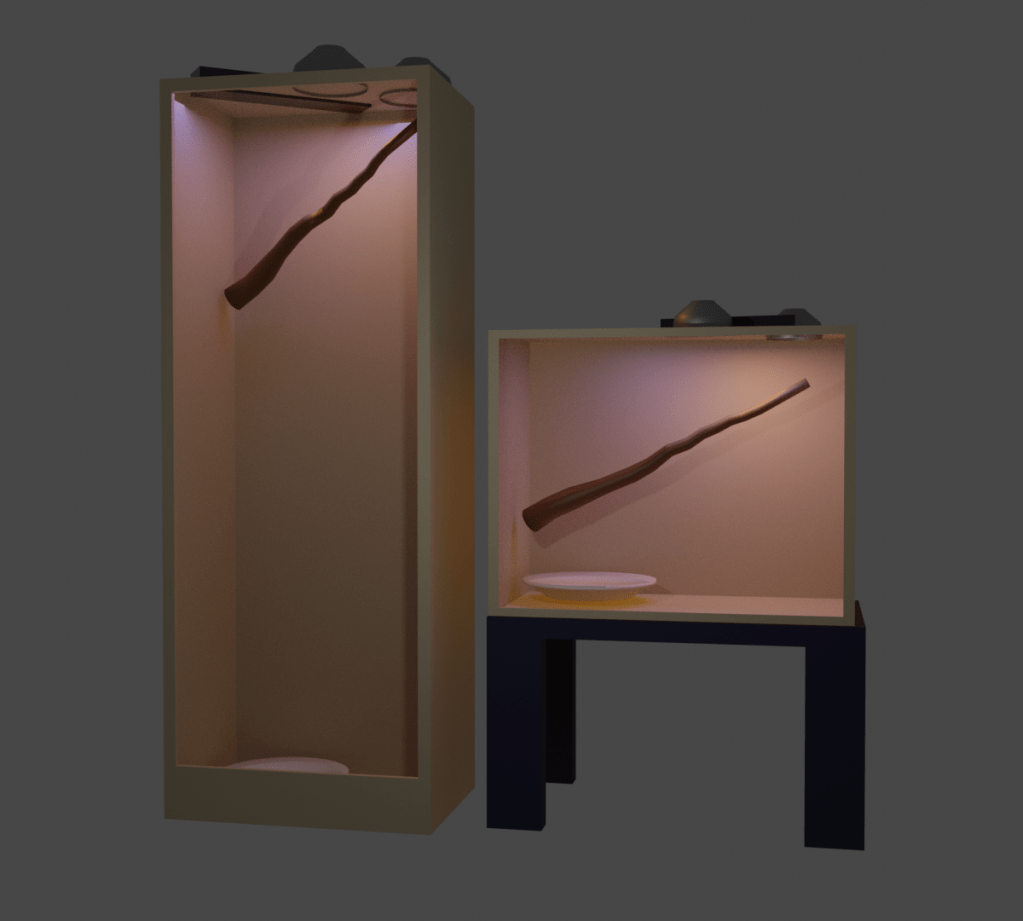
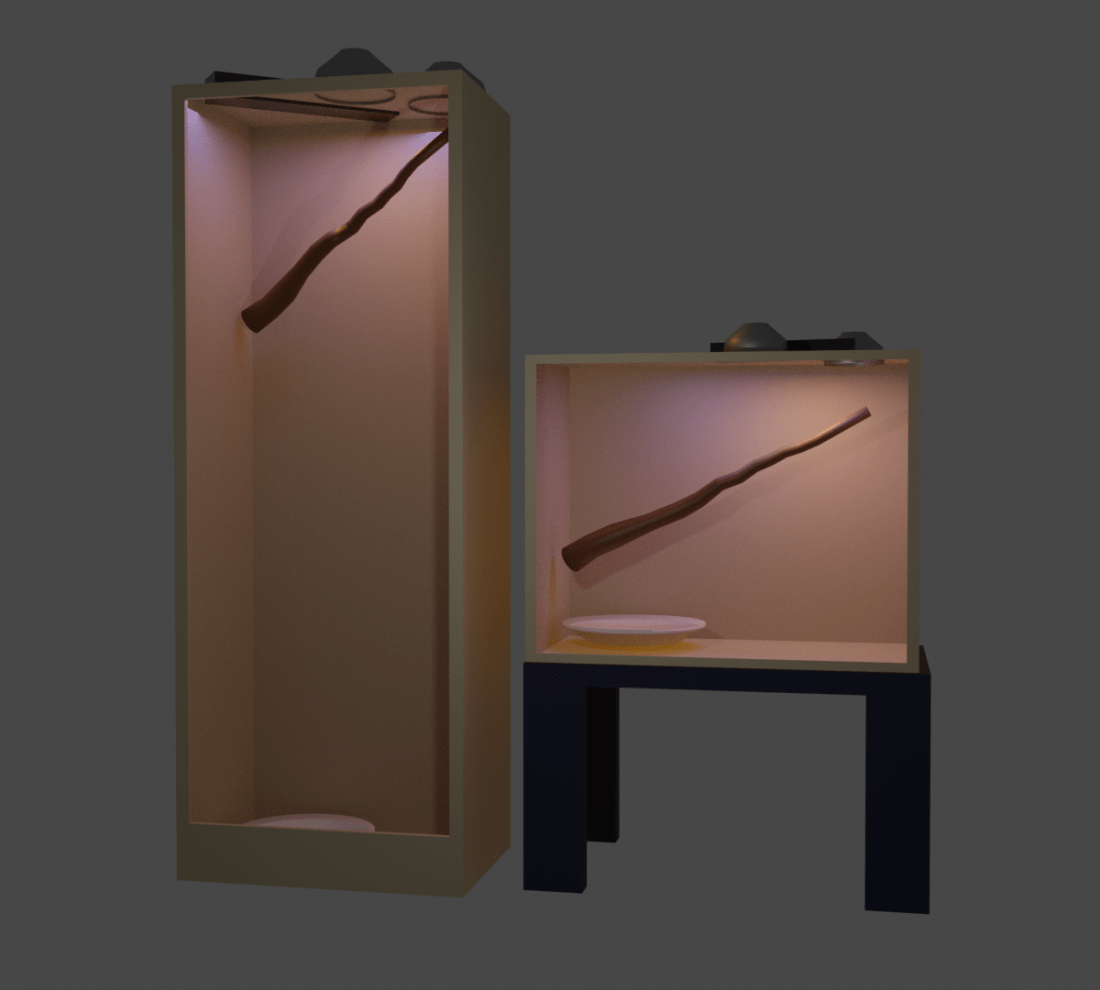
A simplified example: The tall cage takes up a lot of room, but offers little usable space for the animal.

So as an example. A cage that is 2′ x 2′ x 1′ has 4 cubic feet of usable interior room for your pet. A cage that is 2′ x 2′ x 2′ – adding only a foot of depth, has 8 cubic feet of interior space – we doubled the space available! The closer we get to the square shape the higher the ratio of interior space to exterior surface becomes.

Another quick example. A lot of commercial cages are sizes like 6′ x 2′ x 1.5′ – 72 inches x 24 inches x 18 inches. They make us feel like we are providing a lot of room for our animals because – wow – they are 6 feet long! But thats 18 cubic feet. If we were to build a cage that was 4 feet by 4 feet by 4 feet the animal would have a whopping 64 feet of usable interior space!

(I realize a perfectly square cage can be an awkward size to fit into a room. I use those dimensions just to demonstrate the idea Im getting at)

So what happens to useable space when we start to consider a tall cage design? From what Ive seen most tall cages are either narrow, or shallow, or both. The keeper reasons, understandably so, that with all this vertical height what need is there for breadth or depth?

But take a minute and consider how the tall cage design functions for the animal. As an example, lets use a tall cage thats, let’s say, 6 feet tall by 3 foot wide and 2 foot deep. We place a couple halogens on top along with the UV and a bright LED. How far does that useful radiation penetrate into the cage? The light and heat and UV may be too intense at the very top of the cage, so 6 to 8 inches down we start to get into a usable area. But another 18 or 24 or 36 inches down and we loose those optimal temps, and light and UV.

The other important point is that because we have created a tall cage with less depth and breadth we have less room for gradients at the top of the cage. Our basking lamp will cover nearly all the top of he cage, as will our UV and visible light sources. In order for the animal to choose gradients they are forced to move down in the cage – something that they may be reluctant to do simply because the height provides the sense of security they need – and may be an over-riding factor.

If we do the math, our great big tall cage is providing 9, or 12, or 18 cubic feet of usable space. Compare that to the 4x4x4 cage that provides 64 cubic feet of space. Thats over 5 times the usable space of our middle example!

Now I have seen all sorts of work arounds to this design dilemma. And a few of them have been reasonable, if not elegant. Most involve adding additional heat or light to lower levels in the cage. But these kludgey fixes are completely unnecessary.

Rather than ask how we can make tall cages work, lets ask why we thin we need them.

It’s easy to assume that an arboreal lizard or snake or frog needs a tall cage. That somehow having a longer distance from the top of their cage to the bottom is psychologically or behaviorally important. Or that the act of moving way up from a point way down is somehow beneficial. I would argue that it is not. At least not as important as the benefits we get from a cage that provides more usable space, i.e. a cage that is closer to a square.

It is true that some arboreal animals seem to be calmer when they are at the keepers eye level or above. This makes sense because in nature they use height to escape predators. But simply placing the cage on a shelf or stand will provide for this need. Remember, we dont want to advocate for a shallow cage for arboreal species, just not an overly tall one.

So lets see what happens when we build a cage that is 4 foot wide and 3 foot deep and 3 foot tall. Lets say our radiation is on the top of the cage rather than in it, which is a better design for most purposes. The heat, light and UV now reach to the floor of the cage and can be adjusted either by dimmers or by swapping out for different wattage bulbs to achieve that lower temp preference.

We have created horizontal gradients of all the various radiations with this design. The animal not only has much more usable space, but can easily move closer or further away from those sources without loosing the height that gives it an important sense of security.

With just this simple redesign we have increased the usable space for our arboreal pet many fold.

Poisonous VS Venomous

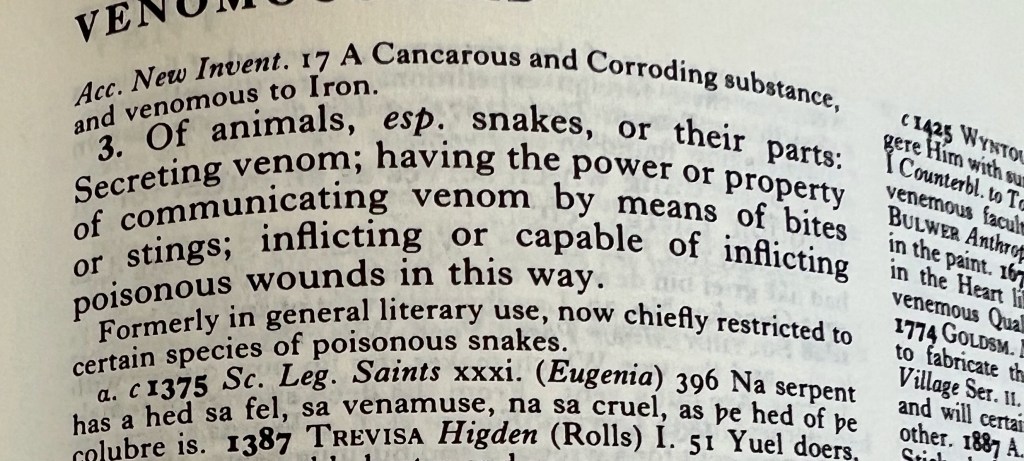
Oxford English Dictionary Definition Venomous and Poisonous

Why BOTH are often correct —

Its become a rather obnoxious trend on social platforms that when ever anyone mentions a poisonous snake, some know-it-all jumps in to correct them. “I think you mean VENOMOUS snake!” And then of course someone even more pedantic cant wait to leap in with something not very witty, like, “Unless its a blabby-blah species and you ATE it!”, and so forth, ad nauseam.

And so I would like to offer this opportunity to anyone who has been publicly humiliated in this manner by a stuffy Facebook friend to get even. You see, there is nothing wrong with using the word poisonous to describe a rattlesnake, or mamba, or cobra.

In fact, the word poisonous was used by all of our famous herpetologists, and back centuries before them by scientists to describe poisonous snakes. Even our modern dictionaries will often use the term “poisonous snake” as an example of the word poisonous in use. The suffix “ous” simply means “in possession of”, “full of”, or “possessing the qualities of”.

So poisonous literally means to be in possession of poison, which our poisonous snakes undoubtedly are!

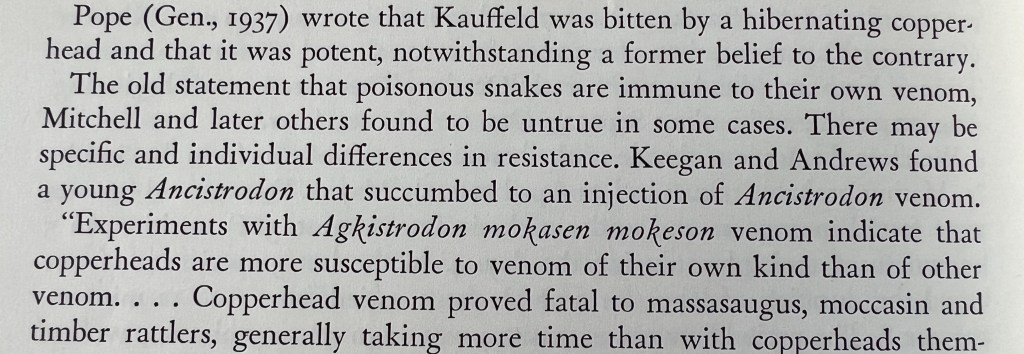
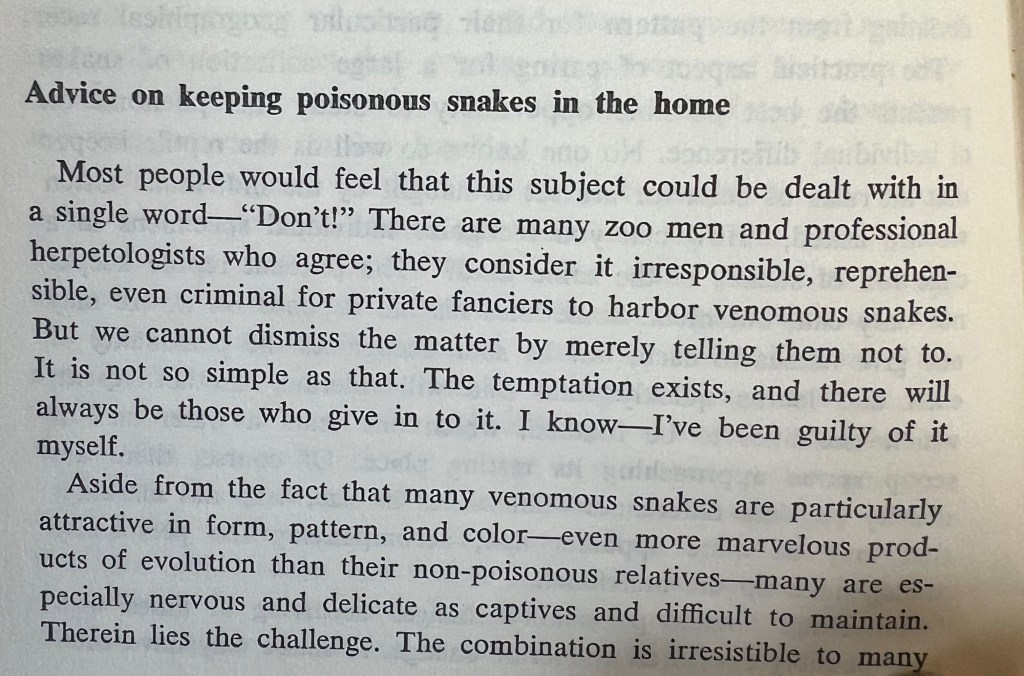
Just a couple of quick examples. The text excerpt below is from The Handbook of Snakes of the United States and Canada by Albert and Anna Wright. Albert was a professor of zoology at Cornell University and together they produced the most authoritative guide to our snakes in the 20th Century. (Its a book I must have checked out from our city library 30 times as a kid!) …

Another example is from Carl Kauffeld in his famous book “Snakes: The Keeper and the Kept”. Kauffeld was Curator of Reptiles at New York’s Staten Island Zoo and the world authority on (poisonous) rattlesnakes of North America. You can see in the text excerpt from his book that he uses poisonous and venomous completely interchangeably. Thats because the two words can mean the exact same thing, depending on the context and author’s intention.

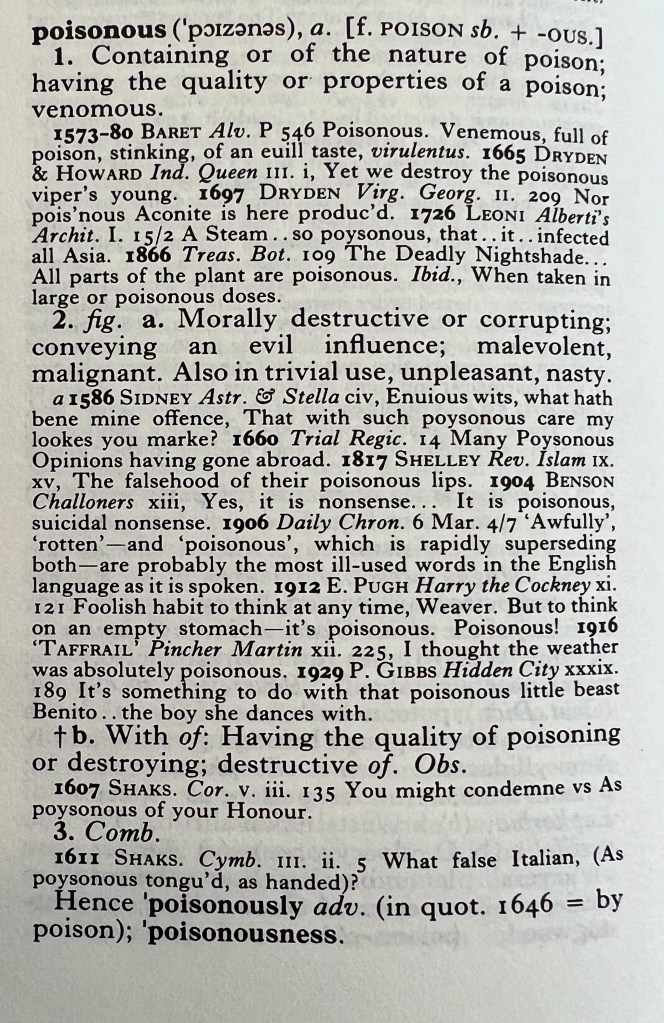
In order to check my understanding on this topic I drove to my library to consult the 22 volume Oxford English Dictionary. The main entry for poisonous was “having the quality of a poison, venomous”. So you see, the world’s authorities on the English language use “venomous” as a synonym of “poisonous”. So dont let some social media jerk tell you otherwise!

When I checked to see how the Oxford English Dictionary defined venomous, I saw more confirmation of the two words synonymy. Notice this is the third definition of the word, not the first. And notice that according to these guys – and believe me, these guys are the last word on the subject – a venomous bite can be delivered by a poisonous snake!

So we have two words that can mean the same thing. They are both correct and can be used interchangeably. But it doesnt mean that they cant have their own nuanced meaning, or even their own common usage.

Venom, after all, is a type of poison – a subset of the larger category. If the intent of the speaker or writer is to convey the broader category of poisonous snake, then there is no reason they shouldn’t. And there is no rational way anyone can logically correct them, unless their meaning is obviously incorrect within the context they provide.

When my son was about 8 and learning all his car makes and models he would continually correct me. If I said “That car almost ran into us”, he would immediately respond, “That TOYOTA almost ran into us!” I would say, “That Toyota is a car too” and he would shrug, probably thinking his first precious thoughts of what an idiot his dad was. But just like a Toyota is a car, a venomous snake is indeed poisonous. In fact, when the super smarty pants mention that members of the Genus Rhabdophis are both venomous AND poisonous they are making about as much sense as saying that hunk of rusting metal over there is a car AND a Toyota! Brilliant, right?

The truth is of course that the word venomous is being used more frequently today to describe biting and stinging animals. (Notice its not often used to describe stinging plants, even those with stinging needles!) But we have many synonyms in our English language. One term does not have to be wrong simply because another is right. As Kauffeld, Ditmars, Pope, the Wrights, and all the other great herpetologists knew, both terms are perfectly appropriate when used in the proper context.

What’s Wrong with Thermostats

Mostly we don’t need them —

Most every care sheet you read will instruct you to incorporate a thermostat of some sort into your vivarium design. So maybe its surprising to read here that I think they are often worthless and even dangerous.

Probably because there was no such thing during the first 20 years of my herp keeping career, we had no choice but to live without them. And when they first showed up on the scene I thought of them mostly as more pet store junk. Later I realized just how dangerous they were!

There is almost no scenario that I can imagine that would require a thermostat. I even asked others to provide examples of when and why they thought thermostats were actually important to herp care. Most of the replies were kind of crazy – like “what if your air conditioner goes out but your heat lights stay on and then the animals bake?”

Like that has ever happened. But the only scenarios that made a thermostat even arguably useful were these totally unpredictable equipment failures, and they were far fetched at best. If your A/C failed, the temperature in your home would very gradually increase over many hours. The situation would be corrected before any actual damage would be done.

Heat waves happen. And they are predicted days in advance. Hardly likely that a heat wave would ever create a problem for our animals, since we could simply unplug one or all of the heating elements in any cage in an unconditioned space.

But that leaves two considerations: How to set up the heating elements for a cage and how to control those elements once in place.

The best primary heat source for reptiles and amphibians is incandescent light bulbs. (Halogens are a type of incandescent which are hotter per watt, and a good choice for many setups). For most cages use flood bulbs for their wider, gentler beam. Do not use the mini-halogens sold at pet stores, which concentrate a small, very hot beam that can easily burn your pet.

Incandescent flood bulbs can still be bought at the Home stores in much of the US. When the US ban goes into effect, as it has in California and many European countries, we will have to by the pet store bulbs – which are expensive and sometimes dangerous – or search out other sources of specialty bulbs. The US ban states that “general use” light bulbs that use a lot of energy to produce few lumens will be banned. This leaves “specialty bulbs” like those branded for the pet or plant / horticulture industry.

Other common heating elements like radiant heat panels and ceramic heat emitters are not suitable for primary heat. (See: The Problem with Ceramic Heat emitters and Radiant Heat Panels) In the unlikely situation where ambient or overnight temps fall into the 60s, these technologies may be useful. But they are not to be used as your primary heating elements.

Deep heat projectors (DHPs) provide infrared B and some IR-A, so they do radiate heat down into the cage. These can be a good choice for overnight heat for some species. Because they produce almost no light and are directional they can be used to establish a thermal gradient even at night.

Under tank heat pads get a bad rap, but usually because they are used wrong. Like the CHEs and RHPs, UTHs can also be useful to boost ambient temps under certain circumstances. It is true that reptiles and amphibians instinctively go to the ground and under the ground to find cooler, more humid conditions. So a warm substrate may not be a good choice for terrestrial species. But for other species like arboreal lizards or snakes or tree frogs, gentle heat from below may be fine. Just don’t set the tank or cage or anything heavy on the power cord – that can cause an electrical fire.

So to provide the right temperatures with our overhead bulbs we have to start with an educated guess. How many bulbs and how many watts? If you are just starting out you may have to learn by trial and error. (Make sure you dont accidentally buy LED bulbs which produce no useful heat) Common wattage for bulbs are 45, 65, 75, 90 100 and 120. The right wattage and the number of bulbs will depend on your cage shape, ventilation, whether the bulbs are inside or out, and the species you are keeping, to name a few of the variables.

Thats why no one can answer the commonly asked question, “What lights do I need for my cage?” Obviously you need to start by asking what temps does my species need. This means what range of temps – since I know you will want to create a good thermal gradient – and also what night temps as well as day temps.

If, for example, you are housing a new corn snake in a 20 gallon long tank with a screen lid (See: Why Aquarium Tanks Make Such Great Herp Housing) you may want to create a warm side basking area of 88-90F (31-32c). So try a 75 watt flood bulb in a 10 inch reflector sold for baby chicks at the farm store. Use a $3.00 thermometer (also from the farm store) or a temp gun to measure the surface temperatures the 75 watt bulb creates. If it hits your target temps you are done.

If the basking area is still too cool, simply try the 90 watt bulb. Or better, leave the 75 watt and get another 10 inch reflector for a 45 watt or 65 watt bulb. I say better because with two reflectors and bulbs you will create a munch bigger warm area and you’ll also have more leeway to tweak temperatures: Two 65 watt bulbs, or a 75 and 45, etc. You can use two bulbs to create more gradual temperature gradients.

And as always, exactly what you want will be informed by the animal you are keeping! Is it avoiding the warm area? If so, why? Does it rarely leave the warm area? The animal’s behavior will be a good teacher if you are a good student!

I have found it often beneficial to use a dimmer in conjunction with adjusting the wattage of the bulbs. The manual slider type dimmers can work, but many keepers are finding the digital, wi-if dimmer / timers to be valuable here. These marvelous little devices solve a host of issues and allow the keeper to really fine tune their enclosure environment.

Here is a link to the digital dimmer / timers I use:
https://www.amazon.com/dp/B0BXP8QL52

For some sensitive species like baby emerald tree boas I have both the halogens and the night DHP on their own dimmer / timer. with these I can control exactly when they come on and their intensity once on. After a couple days I can dial in the exact temperatures and illumination I want.

Almost all lights and heaters, including UTHs and CHEs are dimmable now, but it is worth double checking before buying. And remember CHEs and RHPs are NOT what we want as primary heat sources.

So why are Thermostats Dangerous?

Hopefully we’ve learned how simple it is to create great thermal and visual radiation scenarios for our animals. So we know now that thermostats are not necessary at all. But are they really dangerous?

Thermostats are introduce a complexity (and a cost) that can easily be avoided. The more complex a system is, the more likely it is to fail. And I have seen animals’ lives endangered by failed thermostats, and failed implementation of thermostats, way too many times.

First, the equipment itself can fail. It seems like half of what we buy these days is cheap crap that fails shortly after we unwrap it. Many thermostats sold today are no exception. And when they fail they can allow the once dimmed lamps or heating elements to switch to full power, potentially lethally over heating the caged animals.

But its more likely the thermostats will fail due to keeper error. The probe is placed in the wrong place, for example, or it’s placed correctly but the animal dislodges it. Suddenly it is way down in the shadows of the cage, which it will now try to heat to basking temperature!

So, in balance, the keeper and the kept will both be better off without this expensive and unnecessary addition to our vivarium design. Try to design without them – as many of us did for decades – and see how easy and safe life without thermostats can be!

Are Ball Pythons Arboreal?

Ball pythons are not a semi-arboreal species, even though they have been found off the ground. —

The short answer is no, Python regius, the ball or royal python is not an arboreal species, even though it can be found off the ground in some circumstances. But thats not really the question we should be asking. The important question from the herpetoculturists perspective, is whether Python regius enclosure design should provide accommodations for climbing. And the answer to that question is a clear and  unequivocal – it depends.

I’m writing this article in response to an article by that laid out some evidence for the species proclivity for the trees. So the papers referenced in that article are referred to here.

Im not writing this to refute his paper, per se, but to temper some of the misguided conclusions and subsequent design flaws those conclusions produced. I’ve lately seen a whole slew of cages for all pythons that look more suited to small tropical lizards – crowded with plants and branches and crowded even more with poorly considered “clutter” that serves no purpose – as clutter rarely does.

To an extent, the argument is semantic. What is meant by arboreal or semi-arboreal anyway? These are not rigorously defined words after all. What is important is that we design enclosures to meet the species needs as best we can. And for that we look to their natural history.

The snakes in the hobby come from the northern regions of Benin, Togo and Ghana. This is a semi-arid area of thorn scrub and grasslands. But the primary research sited in support of arboreality took place in the tropics of coastal Nigeria …

“The field study was carried out mainly during the wet season of 1997 … in some localities of southeastern Nigeria ….  These localities are characterized by permanently flooded swamp, rain- forest patches surrounded by cultivations of cassava and oil palms, and dryland rainforest patches.” (1)

So not only were the studies carried out in a tropical coastal area, they were done during the rainy season. One can easily imagine many of the snakes in the area took to the trees just to escape the rising waters. 

The second most prominent study presented as evidence for arboreality also took place in coastal, tropical Nigeria. In this study the pythons were radio tracked. The researchers found that the snakes spent every day burrowed into tunnels, emerging only at night to forage etc.

During their active periods males were discovered off the ground about 2.5% of the time. The females were discovered off the ground even less – about 0.5% of the time. That means the for every 200 female ball pythons observed only 1 was off the ground. For every 200 males, only 5 were off the ground. The author of that paper writes, ““However, both sexes were ground-dwelling in the great majority of [radio tracked] fixes” Does this constitute semi-arboreality?

Note that the first study was conducted in the day time exclusively, during the rainy season of a swampy environment. Even so the researchers discovered many snakes, lots of which were off the ground. The second study states that the snakes retreated to burrows during the day and emerge only at night to forage. There is contradictory information that leaves us wondering what fundamental details we are missing. How could one study show the snakes to be diurnal and arboreal while a study geographically close and in the same ecotype show them to be strictly nocturnal and overwhelmingly terrestrial and fossorial?

Was it the high waters of the rainy season driving the snakes into the trees?

The other line of reasoning in the paper suggests that the presence of birds and arboreal mammals in the diet of wild ball pythons proves the snakes are semi-arboreal. The argument is simple enough: “The snakes eat birds, birds live in trees, ergo ball pythons climb trees”.

Except birds live on the ground too – as do at least one of the “arboreal” mammals in their diet. In fact many of the species that are presented as tree dwelling aren’t necessarily. The galago (a tiny and darling primate) is often found very close to the ground: “…they are usually found in bushy vegetation only a few meters (0 to 5 m) off the ground. They can often be seen in the dense vegetation by the roadside and in ditches.” (2)

The bee-eaters … “They form colonies, nesting in burrows tunneled into vertical sandy banks, often at the side of a river or in flat ground. As they mostly live in colonies, large numbers of nest holes may be seen together. “ (3)

The grey parrots : “May (1996) observed that Grey parrots (Psittacus erithacus) in a Congo basin forest engage in extensive ground foraging, possibly ingesting soil as well as plants.” (4)

The Cisticolas, small warblers that are one of the most numerous ball python prey items are not particularly tree dwelling, and in fact occupy a niche close to the ground: 

“A variety of open habitats are occupied. These include wetlands, moist or drier grasslands, open or rocky mountain slopes, and human-modified habitats such as road verges, cultivation, weedy areas or pasture.” (5)

In fact, the one species we can probably assume is not going to be found on the ground were the bats, and those were consumed by female ball pythons only, instead of the “more arboreal” males. So there is something we don’t understand happening here as well.

The point Im making is that we cant work backwards from our conclusions to evidence. Birds in the bellies of ball pythons only proves they eat birds – it doesn’t prove anything about their arboreality. After all, even giant tortoises eat birds, and no one uses that fact to claim they are semi-arboreal!

“Here we present video evidence of a Seychelles giant tortoise (Aldabrachelys gigantea) attacking a tern chick and pursuing it along a log. Finally the tortoise killed the chick and was observed to eat it. Other tortoises in the same area have been seen making similar attacks… (6)

One thing that is consistent across the natural world is a simple notion “Form follows function”. An animal’s shape and other physical characteristics will disclose how the animal behaves in the world. 

The paper suggesting ball pythons semi-arboreality acknowledges this …

“Snake biologist Henry Astley had this to say on the subject: “Coming from my background (snake biomechanics), NOTHING about the ball python morphology is consistent with an animal which “spends all their time in a termite mound. Their skulls have no reinforcement or digging adaptations, their eyes aren’t reduced, they have distinct “necks” (as opposed to the robust “train locomotive” morphology of most burrowers), and have no specialized digging rostral scales. Anyone who claims they spend their whole lives in termite mounds needs to go take a look at Loxocemus and Calabaria to see *real* burrowing morphology, then defend how balls can have the lifestyle claimed with zero morphological adaptations.” 

The same argument can be made in regard to arboreality. Ball pythons have no physical or behavioral characteristics that would suggest they are adapted to an arboreal existence. They have none of the rigid muscularity of the tree boa, they don’t have the big eyes of the boomslangs or other sight hunters, they don’t have the enlarged scales that the mambas and other tree dwellers often display, and they don’t have the strength nor elongated shape that would allow them to span spaces between branches like the typical tree snakes do.

In short, they don’t have the form of an arboreal species because they are not an arboreal species.

So why does this semantic argument matter?

It matters because – in typical social media fashion – the interesting information offered was not taken in context of a broader base of knowledge because there often is no broader base of knowledge. Instead the new information was used by sudden authorities to cudgel the poor ignoramuses that hadn’t had a chance to read the paper yet. So it goes.

But worse, the new information was mis-used as guidance for creating ball python enclosures. The internet now abounds with images of ball python enclosures that are more suited to small tropical lizards or tree frogs than to pudgy pythons from arid flatlands. Vivaria packed with tropical plants, criss-crossed with branches and choked with “clutter” that serves no known purpose are now proudly presented as the latest and greatest creations of the herpetoculture literati.

These designs do not reflect the environments of the ball pythons in the hobby.

So if semi-arboreal enclosure designs arent right for ball pythons, what is? First I want to say clearly that none of this in any way condones the keeping of ball pythons in minimalist plastic tubs. There is nothing that can justify that form of animal abuse.

And there certainly isn’t anything wrong with adding a branch or two to a ball python’s enclosure. It wont hurt and it may provide some additional exercise that these little fatties often need. But packing our vivs with branches shouldn’t be advised, and certainly shouldn’t be insisted upon by the various care sheets floating around. 

Note too that the four walls of a cage often produce unnatural behaviors in our animals. So the many photos we see of captive ball pythons balanced on a branch on a cage dont necessarily depict anything natural. Especially when those four walls do not provide for the subterranean preferences of the animal.

More important is a deep, slightly humid substrate that facilitates burrowing. And a warm overhead incandescent lamp. Also something heavy and rough to aid shedding could be important. A surface layer of dried leaves, grasses or even straw to act as a mulch, help preserve substrate moisture and ensure a good humidity, light / security and temperature gradient and would complete the very basic setup for this species. 

If, in a addition to these basics, a keeper wanted to add plants and climbing options there would be no reason not to, as long as the enclosure was big enough to do so without crowding. The design emphasis however should be exactly what is missing in almost all of the new designs seen today – a deep, loose substrate or other subterranean accommodations with proper humidity and temperatures to reflect the place they spend 90% of their time in nature.

1.) “Luiselli, Luca, and Francesco Maria Angelici. ” Sexual size dimorphism and natural history traits are correlated with intersexual dietary divergence in royal pythons (Python regius) from the rainforests of southeastern Nigeria .” Italian Journal of Zoology 65.2 (1998): 183-185.” – 

2.) (Charles-Dominique, 1977; Napier and Napier, 1967; Nowak, 1997)
https://animaldiversity.org/accounts/Galago_demidoff/

3.) https://en.wikipedia.org/wiki/Bee-eater

4.) Soil-Eating by Grey Parrots in Cameroon: An Answer to Mineral Deficiencies or Toxins in the Diet? https://medium.com/@agreenmoment/soil-eating-by-grey-parrots-in-cameroon-an-answer-to-mineral-deficiencies-or-toxins-in-the-diet-b2ffc60e2fb7

5.) https://en.wikipedia.org/wiki/Cisticola

6.) https://www.sciencedirect.com/science/article/pii/S0960982221009179

The Sun

The Role of Radiation in Herpetoculture —

The sun bathes the earth in heat and light – radiation. Our animals have evolved over millions of years in an intricate dance with that radiation. They have evolved to operate best within specific wavelengths of solar radiation – from the short UV wavelengths, thru the longer visible wavelengths and on to the longer still infrared radiation. Some species are adapted to utilize reflected radiation from the earth’s surface.

The importance of radiation in the animal’s life can not be over stated. The sun (heat and light), together with the earth (substrate), the wind (ventilation) and the rain (water and humidity), make up the four key elements to enclosure design. They can not be considered separately – they are inter-related parts of the whole.

A personal anecdote to illustrate: When I was a kid of 12 (1970!) a friend talked his dad into letting us convert the 8 foot diameter, 2 foot tall stock tank he had bought as a kid’s splash pool into a habitat for the snakes, turtles and frogs we spent our summers catching. We built an island of rock and branches and pine boughs in the center and filled the tank with 8 inches of water to form a moat around the outside. The animals we kept this way were the healthiest herps I have ever kept. Which, when you think of it, is a pretty sad indictment of our current level of captive care!

But something happened when we brought the animals inside for winter. They became lethargic, feeding slowed or stopped. The snakes developed infections on their belly scales. The turtles eyes would swell shut, frog’s bellies and legs would turn red with bacterial infections.

Even though we tried to get their captive care right, we were obviously missing key elements of care. But what amazed us was the quick return to health we would witness when spring finally came and we got our animals back outside. We used to say the sun put the wild back in them! Their activity levels would jump, their ailments would heal, their appetites would return. It was magic.

What we were seeing of course was the power of the sun to heal, to rejuvenate, to stimulate. Keepers who ignore that power – that intimate relationship herps have with the sun – will never keep their animals at peak health. Nor will they be able to observe truly natural behaviors. Every aspect of our herps’ physiological processes depends not only on solar radiation, but on proper levels and the balance of that radiation.

Reading through “The Bible” of herpetological medicine (1) drives this point home. So many of the metabolic processes that are critical to the animals growth, reproduction, nutrition, disease resistance, and social interaction are temperature dependent. They are most efficient when the animal reaches its preferred operating temperatures, and decrease in efficiency the further the animal moves away from that optimum, above or below.

It is important to note, however, that in almost all cases there are two unfortunate complicating factors for keepers. One, we really don’t know what that preferred temperature is, even though many care sheets pretend they do, and two, that preferred temperature will certainly change with the hour, the day, the week and the month.

How many times have we heard a frustrated keeper exclaim “I dont know what could be wrong, the temps are perfect!”? Of course, they dont know if the temps are perfect. The only evidence they have is a care sheet written by who-knows-who and uploaded to a web space somewhere. We try to overcome these limitations of our knowledge by better enclosure design, as we’ll see.

I want to talk briefly about some specific aspects of the radiation producing technology we use for our herps, but first I want to acknowledge where much of our current understanding comes from. Even though many of us have noticed the change brought about in our herps when they are brought outside to be reunited with the sun’s warm rays, it wasn’t until the work done by Dr Furgeson of UVB fame, and the team of experts at the Reptile Lighting Facebook group, that we really started to comprehend the how and why. We simply would not know what we now know without their years of education, research, experience and a nearly superhuman patience with persistently confused questioners like me. All of us who endeavor to do what’s right for the animal’s in our care are forever indebted.

So having said all that, we can finally talk about the specifics – which are deceptively simple:

  • Our herps need a range of temperatures to choose from
  • The primary source of heat should be overhead, incandescent bulbs
  • Although not often needed, ambient heat can be provided
  • Visible light should mimic the sun’s visible spectrum
  • Visible light should be bright
  • Natural levels of UV may be required and are often a safe bet

Of course, the devils in the details. But I think if a few simple concepts are understood, radiation design doesnt have to be rocket science. Here I want to relate these concepts. In other articles I will go into more details.

Far-Infrared, IR-C, Ceramic Heat Emitters and Radiant Heat Panels

Im going to go out on a limb and say these “radiant” heaters are the most misunderstood of the heating options we have. They dont radiate, for example! And the marketers often mis-represent how they work, and make erroneous claims about how to best use them.

First, it’s important to understand that IR-C, the far infrared radiation that ceramic heat emitters (CHEs) and radiant heat panels (RHPs) produce is not natural – it is not a wavelength the sun produces. Second, the far infrared radiation they produce does not “radiate”. It is not projected or radiated from the devices like the warmth from a light bulb is. The heat produced by these “radiant” heaters slowly passes from molecule to molecule via conduction. The majority of the heat produced floats up and away from the heat source unless it is trapped by the cage walls.

Finally, the particular long wavelength they produce does not penetrate the animal’s dermis. Unlike the sun’s warming rays (which are mostly near infrared, or IR-A), the far infrared wavelengths produced by CHEs and RHPs is not absorbed, so it is not distributed by the animals circulatory system as the sun’s warmth would be.

Our animals are not adapted to interact with, nor are they able to directly utilize the far infrared radiation produced by these devices, and so they should not be used as primary heat sources.

In the rare cases that additional heat is needed to boost ambient temps, these, along with properly used under-tank heating pads, can be useful. But even for animals adapted to night substrate heat it is better to warm the substrate thru the day with natural IR-A radiation from incandescent bulbs, then let it cool naturally at night. The re-radiated heat from the substrate, or basking rocks will, in fact, be the far infrared radiation produced by radiant type heaters, but that doesnt mean you should use them to create the substrate heat in the first place.

Near Infrared, IR-A, Incandescent / Halogen, Deep Heat Projectors

People are sometimes surprised to learn that near infrared producing lamps are used to treat a variety of diseases in hospital settings. The warming rays of the sun are in this near infrared, or IR-A wavelength and not only feel good on our skin, but are indeed healing.

Near infrared radiation passes through the outer layers of an animal’s skin, or dermis, to warm the nerve endings and the blood near the skin’s surface. The animal can distribute this warmth throughout it’s body via the circulatory system. I have often seen lizards and snakes warm their whole bodies by exposing just their heads to the warming radiation – both in captivity and in the wild. This is one way they can control the delicate, heat driven physiology of their bodies – and this is something they can not do with CHEs or RHPs.

Near infrared radiation is simply and cheap to provide. Incandescent bulbs (halogens are a type of incandescent bulb) produce near infrared abundantly. They are easy to implement in our vivariums too because they can be used with digital or manual dimmers and timers.

How and where to install them I’ll leave for another article, but as a general guideline they should be closely aligned with the UV radiation and with the visible light producing element if a light gradient is part of your design. Simply place a thermometer under the basking lamp and adjust the lamps output with the dimmer to achieve the desired basking air temps. An inexpensive thermometer gun will provide the surface temps. You can make big adjustments by just swapping out the bulb or bulbs with higher or lower wattage alternatives. Start with a 75 watt or 90 watt bulb and go from there. In the US halogen / incandescents bulbs are still available and much cheaper at the home stores than the pet stores. Look for their plant bulbs if they have phased out their general / home use incandescents.

Ultraviolet UVB

The UV spectrum of solar radiation has been shown to be important to the health of a number of captive reptiles and amphibians. We know in part why this is so, but there is much we dont know still. Snakes, for example, seem to live long, healthy lives without UV in a captive environment. This may be because snakes evolved from species that lived subterranean lives. Like some nocturnal lizards, they may have learned to survive without the UVB that is sought out by other reptiles.

At the same time, UV radiation has been shown to produce a physiological reaction in snakes, so there may be benefits to providing UVB that we are just not aware of yet.

In many lizard species the role of UVB is better understood and of unquestionable benefit.

Unfortunately, many pet branded products that are supposed to provide UVB actually do not do so at a beneficial level. I’ll cover this topic more thoroughly in another article. For now just know that reading through the guides on the Reptile Lighting FB Group will be important if you want to do whats right and not waste money.

Visible light, LEDs

The sun is incredibly bright. When we move from an interior space to outdoors our eyes adjust, our pupils contract, and the perception of the different intensities of light are diminished. We dont realize how much brighter it is outdoors.

Back when cameras were manual rather than digital I could measure the amount of light in a vivarium I built by using the cameras aperture and shutter settings. I wanted to create the same brightness in the enclosure that the animal would experience in nature. At that time it was nearly impossible to do so. Today we could do better, but the cage would be blindingly bright as we got close to the outdoor levels.

But there is reason to believe that the animals respond to at least very bright light. And of course the distribution of color within the visible spectrum might also be important. A “sunlight” colored LED light of 6000 to 7000K is often recommended. The brightness, or lumens, should be high. Unfortunately I dont think we know how bright is bright enough.

There are expensive LED lights available specifically for herps. I have used portable LED work lights that are very bright and create a “shaft of sunlight” effect in taller cages. Coupled with a halogen and possibly a UVb light we can get much closer to what the animal is adapted to than we ever could before.

1.) Mader’s REPTILE AND AMPHIBIAN Medicine and Surgery, STAHL and DIVERS, Copyright © 2019 by Elsevier Inc.

Nitrogen, Nitrates and Nitrites

Lions and Tigers and Bears, Oh My! —-

After a lot of years trying different substrates for herps, I found a good quality potting mix to be simply the best. And I recommend Miracle-gro potting mix because it has proven to provide the most consistently high quality product. (See: The Great Substrate Debate, and Comparing Bioactive Substrates)

There are a few folks who have raised concerns over the “chemicals” in Miracle-gro Potting Mix (MGPM), largely because they dont quite understand the science around this issue. The typical concerns reflect an irrational fear based on an incomplete understanding.

The chemical most often singled out as dangerous is “nitrogen”, present in MGPM as ammonium nitrate, a chemical compound with the chemical formula NH₄NO₃. This nitrate is used in massive quantities as a fertilizer (nutrient) for vegetables, lawns and general crop production. It is generally considered harmless unless large quantities are breathed in or consumed.

Miracle-gro potting mix contains 0.2% nitrogen, 0.07% phosphorous and 0.2% potassium. This is obviously a minuscule amount, but even this small bit quickly dissipates. Nitrogen is not only taken up by plants but is broken down by bacteria into atmospheric nitrogen which joins the air. Nitrogen also moves freely thru the substrate so rinsed out of the substrate when watered. Typically the available nitrogen in MGPM is gone within a couple months of opening the bag and emptying it into our vivariums.

But while it is present, is it harming our animals? The short answer is no, not at all. Some of the concern may come from the fact that nitrates can be harmful to gill breathing organisms. When nitrate levels get too high oxygen absorption via gills can be inhibited. This is Aquarium 101 – something we all learned when setting up our first fish tanks. But concern over nitrates in fish tanks doesn’t translate to adult animals that do not breath thru gills.

Infants are also sensitive to high nitrate levels because they haven’t developed the gut bacteria needed to convert nitrate to harmless (actually beneficial) forms such as nitric oxide. Once we are past a few months old, nitrates are harmless to us. In fact food processors add nitrates to meats like ham and bacon, and a number of vegetables have nitrate levels of 500 – 1000ppm in them naturally!

So obviously the fear that nitrate is going to harm our animals is completely unfounded. We eat nitrate as part of a healthy diet. Nitrates are beneficial to our health (although the nitrosamines processors put in preserved meats is suspect in my opinion).

None-the-less, some will respond to all this evidence by saying “I dont want to poison my animals even a little bit!” This is probably where their unfamiliarity with basic science is probably most apparent. It would be like saying “I wont put salt on my fries because I dont want to poison myself even a little bit”. There are many things that can kill us in too great a quantity – salt, vitamins, even water. There is very long list indeed. But a little salt, or a little water, isnt “a little poisonous”. Obviously our bodies easily deal with these smaller amounts, and in fact, just like nitrogen, can not function without them.

So even though the evidence is clear, I want to add some personal experiences. I have kept dozens of species of herps on MGPM. Species like snakes, lizards and turtles, but also frogs like horned frogs that burrow down into the substrate for much of their lives. And I’ve kept dart frogs on MGPM that is only partially covered by forest litter. The frogs were in contact with the potting mix frequently. Finally, Ive used MGPM as a substrate in an aquarium I created for tadpoles of red-eyed tree frogs and Dendrobates. The tadpoles thrived in this tank and metamorphic into healthy froglets.

I have even raised isopods an springtails on MGPM for multiple generations.

So lets find things to worry about that are actually threats and stop beating this dead horse!

1.) https://extension.missouri.edu/publications/wq252

Managing Substrate Moisture

A Critically Important and Often Misunderstood Aspect of our Hobby —

The substrate in our vivariums has some important duties. But they can not perform these duties if they have too much or too little moisture in them. Different substrates handle water differently. Some work to our advantage, and some work against us. A good quality potting mix is the best choice for substrate in part because it was carefully designed to handle moisture in the way we, as herpetoculturists, want it to. It both retains moisture, and drains well – apparently contradictory traits! (See: The Great Substrate Debate)

Coconut waste products like Eco-earth, etc are not as useful as substrates because they do not handle water like we ant our substrate to. (See: What wrong with coconut husk substrate?)

The worse substrate is top soil. This comes as a surprise to one keepers who have been told for years to use top soil in their vivarium substrate mixes. This could be because in Europe where much advice about bioactivity originated, top soil is a very different product. In the US top soil is not sanitized and so contains the pathogens – viruses, bacteria, parasites – that we might find in nature. Top soil also quickly compacts, making it totally unsuited for vivariums – even in small quantities.

Simply put, substrates must balance air and water content. Both plant roots and bioactivity are completely dependent on this balance of air and water. when the water content drops too low, bioactivity stops and plants wilt. But just as important, when water content is too high, our aerobic (oxygen using) bacteria are replaced by anaerobic bacteria, and our plants drown, or have their roots rot in the soggy substrate.

An often overlooked, but critically important aspect of substrate moisture is it’s role in providing humidity and humidity gradients. (See: The Humidity Mystery)

Two features of natural set-ups that seem to often promote over watering are misting systems and drainage layers. Drainage layers should almost never be used, and misting / rain systems should only be used when the species or the vivarium benefit from it. (See: Why Drainage Layers Suck , and When and How to Use Mist and Rain Systems)

So how do we maintain the critically important substrate moisture levels? In practice it couldn’t be easier: When the substrate dries down to the point that bioactivity is dropping off and our plants have just begun to wilt, we re-wet the substrate by adding water.

But the devil is in the details. We have to learn what the right substrate moisture levels feel like – even what they smell like. And this takes some practice. The good news it isnt hard and you have some lee-way – its a forgiving system.

Right out of the bag our substrate (Im assuming your using a quality potting mix like Miracle-gro potting mix) will likely be wet.Quite possibly too wet. If this is the case just spread it out across the flor of the cage 3 to 6 inches deep and give it a few days to dry down. Heat and ventilation will aid in this.

You can easily monitor substrate moisture simply by scooping up a fistful and examining it. You want it to be dark and feel cool. It should be slightly damp – not wet. It should not clump when squeezed into a ball, but easily fall apart when pressed on. If it clumps it’s too wet. If you can squeeze even the smallest amount of water out it is too wet.

Our vivariums are integrated systems. The elements of design – the wind, earth, sun and water have to be considered together because they all influence each other. So how long it takes for our substrate to dry down, when and how much water to add, will depend on the elements of this system. All I can do is offer some examples.

A 10 gallon aquarium with 3 inches of potting mix substrate and a screen lid with a 45 watt incandescent overhead may take 2 to 3 weeks to dry down. At that point the top layer of substrate may be dry, while moisture at the lower levels may be just barely detectable. Your plants (I suggest pothos or other hardy species) may be just starting to wilt. The over all humidity of your vivarium will have dropped and even the humidity under surface litter or cover will be reduced to the lower limits f what is acceptable for the species you are keeping.

At this point you may add a half to 3/4 of a gallon of water to this 10 gallon tank. And you can just pour it in anywhere. If you are using a good quality potting mix the water will be dispersed through the substrate evenly in a matter of hours. (Note, coconut waste substrates will not disperse the water well and should be avoided)

Another option is to use a hand pump sprayer to rinse down the walls and plants in addition to adding water every couple weeks. You shouldn’t do this is it isnt necessary and you should do this more than necessary. Ive used this method to rinse animal waste off plants in arboreal snake enclosures, for example. And Ive used it as stimulus or enrichment, like a spring rain.

What you dont want to do is over mist, over water, over use your rain or mist system. The vivarium has to dry down well between waterings. Think of a temperate climate where a rainy day is usually followed by many dry days. The dry, sunny, breezy weather is critical to the health of the ecosystem. The animal’s behavior changes depending on this weather, but they are all adapted to the changes and will respond naturally to them.

Tropical frogs, terrestrial snakes, burrowing lizards, will all use the substrate moisture as needed. A dart frog will quickly establish retreats that remain very humid due to evaporating substrate moisture, even though the surface they are sitting on remains dry. Terrestrial snakes like ball pythons and many Colubrids will burrow thru the potting mix, or curl up under the forest litter you provide, especially when shed cycles approach