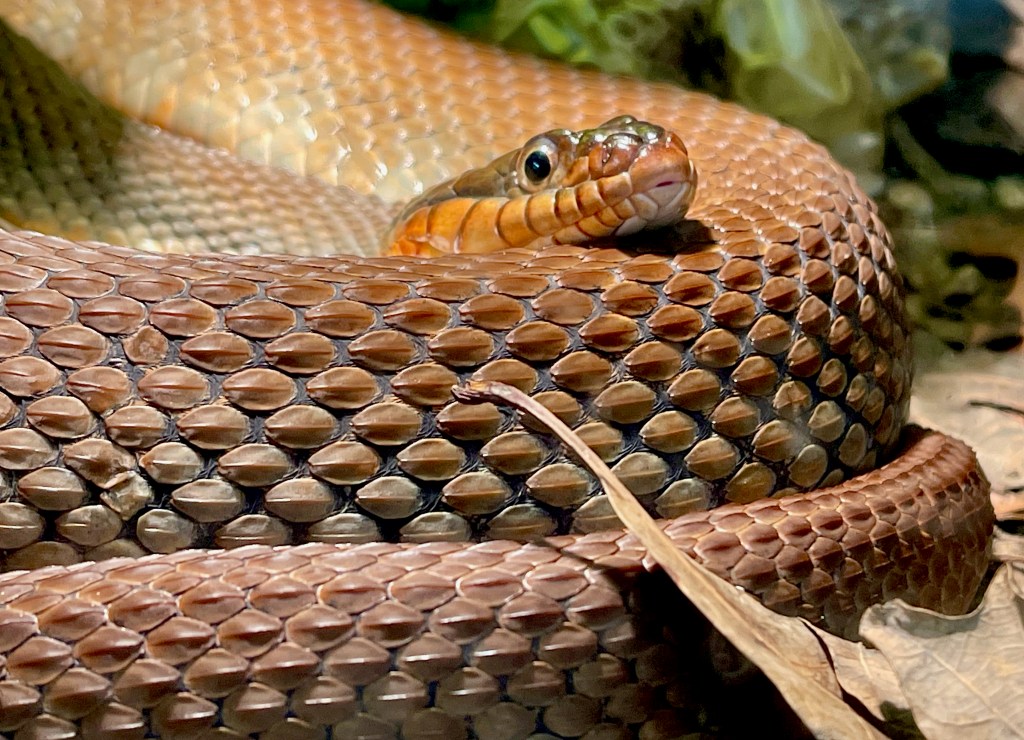
Feeding Garter Snakes – Why so much bad advice?

Please feel free to share this to help clear up the confusion around feeding garter snakes!

Cutting to the chase: Feed baby garter snakes chopped up night crawlers – adding a *tiny* bit of quality vitamin / mineral supplement every third or fourth feeding. Introduce chopped pinks sometime in the first couple months and transition to whole pink mice, eventually whole pink rats, when it’s convenient to do so. Feed small prey items – the garter snake should always be able to quickly and easily swallow its food. Do not “dust” supplements. Add a tiny pinch of the powder on a tiny part of the food – don’t cover or coat the food item. Supplements are entirely optional. Nutrition in the night crawlers is perfectly adequate, regardless of what you read online. Do Not feed fish flesh, organ meat, silver sides, frog legs, etc. These are not in any way beneficial, and potentially harmful.

Important Details:

I think my experience (see below) qualifies me to offer my opinion on garter snake care and feeding – mostly feeding. I don’t think any species of snake is so poorly fed by so many well meaning keepers than garter snakes. This is due, I suspect, to the fact that they will accept a wide range of food items – which gives keepers leeway to provide a wide range of inappropriate, or maybe just less than ideal, foods. 

The other problem is the God like trust that new keepers tend to place in some online information sources – some of which are down right wrong, a few of which are providing even dangerous advice. As a result, many captive garter snakes are being fed a less than great diet, while keepers are wasting time and money trying to met the erroneous diet suggestions offered by online “experts”.

The biggest mistake garter snake keepers make is offering less than whole prey. It is all too common to see online advice that emphasizes the importance of a “diverse diet”. This is hooey. Trying to feed a diverse diet will almost certainly guarantee one thing: you will be feeding a less than optimal diet. 

But we humans hear about the importance of a diverse diet all the time. It MUST be important, right? Wrong. Humans need to eat a diverse diet because too many of us subsist on pizza, cold cereal and hamburgers – unhealthy and nutritionally incomplete sources. Nutritionists and our doctors beg us to diversify our diet because they know we are missing out on many of the nutrients that we need, and that we are getting too much of the things we dont.

This is not the case for our snakes – unless we try to feed a diverse diet. Those who mistakenly emphasize a diverse diet always do so by adding nutritionally incomplete items to the snake’s diet – usually ish flesh or organ meat such as chicken hearts. How much sense does that make? It would be like replacing your kids healthy breakfast with chocolate cake one day a week for the sake of diversity in her diet. If you care about providing a healthy, balanced diet to your kid, or your snake, pursuing diversity over common sense healthy food is counter productive. Lose the organ meat, lose the fish flesh.

Rodents are 100% nutritionally complete. This is explained in Mader’s “bible” of reptile and amphibian veterinary care. What this means – because people seem to find this impossible to believe – is that ALL of the snake’s nutritional needs are provided for by the nutrition contained in rodents. You can not improve on whats available – ONLY DETRACT FROM IT. 

So every time you skip a rodent meal to feed your snake fish flesh or chicken hearts, you are robbing your snake of nutrition it needs. So why do it? If you think the snake “loves” chicken hearts, you are being that parent you see at the grocery store with a shopping cart full of Lucky Charms and Mountain Dew because their kids LOVE those things. Don’t be that parent. 🙂

A quick note about fats and hair. Keepers sometimes assert that both hair and the higher fat content of rodents (particularly rats) can be a problem for garter snakes. The jury on problems associated with hair ingested by garters is still out, but rodents are not the natural diet of many wild garters so it makes some sense to me that excess hair may cause problems. So to be safe, I have never fed any “haired’ rodents to any of my garters – not even fuzzy mice.

Fats are a different issue. Rats have a somewhat higher fat content than mice, and mice a somewhat higher fat content that night crawlers. Eating fat does not make you (or your snake) fat. Eating too many calories, regardless of the source, is what makes you fat. So who feeding rodents feed less. Problem solved.

Worms are the preferred Night crawlers, since some species – like those known as compost worms or red wigglers – are toxic. Ive read a number of “experts” claim night crawlers have low calcium, but almost all of the night crawlers available in the US are collected from areas where the soils are high in calcium. (Most night crawlers sold as fish bait, which is where almost all of us get our crawlers – are collected from Canadian gold course). The limestone bedrock that underlies these areas is rich in calcium and that is what ensures the soils are also calcium rich. The night crawlers black poop is ingested soil – calcium rich.

Night crawlers have a good Ca:P ration and are nutritionally dense. They are a very good food to get your small garter snakes off on the right foot. Consider that many of the garters found in more urban areas will consume basically nothing but night crawlers their entire lives. I have a number of areas near me where Plains garter are common to abundant. And these are in-town neighborhoods where the snakes live on mowed lawns – no natural prey other than the millions of night crawlers that emerge every summer night.

The concern that night crawlers will transmit parasites is unfounded. Garter snakes have evolved over millions of years to exist symbiotically with organisms found in these worms. In fact, we may well find that the snakes with the organisms are healthier than the snakes without them. We see this with our own gut biome, and we see it with the beneficial bacteria that develops on frog skin when the young frogs are exposed to naturally occurring bacteria found on live plants and in live soil.

Silver sides, any type of live fish or live frog / toad are useless additions to a garter snake’s diet. For starters, “silver-sides” is a brand name, not a species of fish. They can, and do, use more than one species to make Silver-sides. Most of these species are harmless. At least one is not. Live fish, even guppies, may harbor parasites that actually are dangerous, as y frogs and toads. And since they provide NO benefit – why risk it? 

Finally, I often read that a keeper feeds this or that because their snake “loves” that food item. They don’t. Unlike humans, snake do not “love” food. Thats why, unlike humans, there are no fat snakes in nature. Unlike humans, snakes eat to live, rather than live to eat. They may eat some food items more aggressively than others, especially if they are very hungry, but don’t mistake that for enjoyment. Don’t be that parent that feeds Fruit Loops because their kid “loves” them. Be that parent that feeds their kids a carefully considered diet that will ensure their good health and long life. They’ll thank you later.

About Me: Ive been keeping a variety of herps for half a century or so. I’ve kept hundreds of species and thousands of individual animals. Ive most often designed naturalistic enclosures that evoke natural behaviors. I enjoy discovering the biological basis of quality care. I was pre-med at a major US research university where I studied biology, physics and chemistry as well as the ecology and evolution of natural systems. I have read widely on captive care (most of which is hooey), veterinary care, parasites, natural history, and related areas of herpetoculture. Ive chased garter snakes – and every other herp I could find – all across the US and a half dozen other countries.
My understanding of herps in captivity is based squarely on my observations of them in nature and the actual science of their physiology. Much of what we read online is designed only promote sales, clicks, likes and egos and should be ignored.

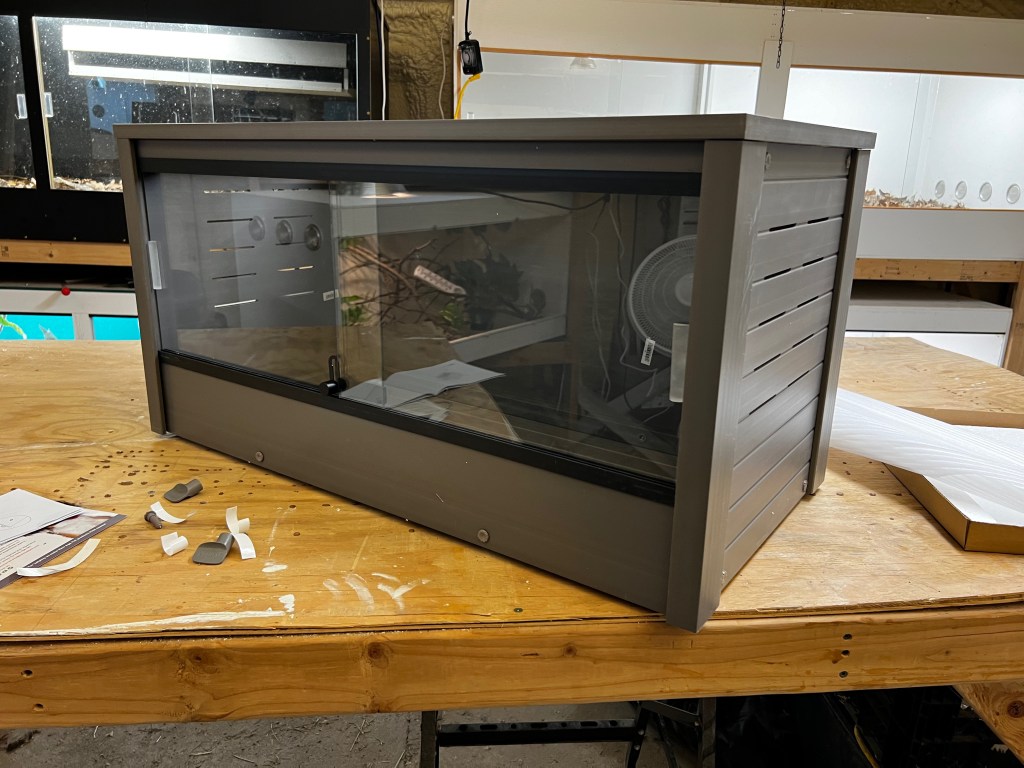
Review of the EcoFlex Mojave 36″ Cage

Over all this appears to be a good, sturdy cage – at a very low price. I am impressed with its build quality and a couple key features often lacking in commercial cages. 1. A tall substrate dam – perfect for 4 inches of Miracle-gro potting mix (see the articles further down about substrate, Miracle-gro, etc. Also read why we DONT want a.) clean-up crews, b. drainage layers, or c. thermostats in our cages – believe it or not)

2.) A screen top. And yes I know you hoarders want to stack your cages. This company (and its selling under other names too) makes a separator that allows stacking with the overhead lights. Screen tops are IMO the best option for most species. we often underestimate the need for good ventilation. And this cage design has slatted vents at each end in addition to the screen top. Very good.

The down side o the smaller versions of this cage – it comes in roughly 2 for, 3 foot and 4 foot widths, is that the screen top doesnt allow as much room as you might want for UV, infra-red and visible light. You could mount an LED strip or small shop type light inside along the front edge though, leaving the top screen for UV and warming near-infrared.

The overall design is a bit squishy with the tall substrate dam. I prefer the looks and functionality of the design I have tutorials for below. But I know many prefer to buy – and this cage is the best option for the cost that Ive seen.

When building here are some important things to keep in mind.

1.) Finger tighten the plastic screws initially. Put everything together loosely and then go back and snug the screws (bolts) up.

2.) Be careful with the plastic “wrench” that comes with the cage. It is convenient, but with just a little too much pressure you will strip the bolt head and the screw threads. And then you will be screwed. They do not have to be all that tights, so just snug them up.

3.) Think before attaching the front lock a the plastic finger pulls. I placed mine too close to the edges of the glass and they disappeared behind the lip on on end, and butted into the lip on the other. So look and think before you adhere them to the glass.

4.) Consider using silicone to seal the seams along the back and around the bottom. I would leave the top alone so it’s easy to remove. This step is not necessary if you are not doing bioactive, and may not even be necessary for many drier bioactive – read the article below on substrate moisture. Too much moisture is probably the single biggest problem with bioactive enclosures!

5.) The screen is quiet heavy – which is good because it is sturdy, but will block UV. So check with the FB Reptile Lighting group to see if they have the % UV blockage for this cage and calculate accordingly.

Finally – Id be happy to hear your feedback on this cage. Visit the FB Group:
https://www.facebook.com/groups/naturallykeeping

If you would rather build your own, here is my simple, but high quality build you may like:

https://www.youtube.com/watch?v=bxJ0FGn-OMU&t=66s

Costs and Links for 4×2 Cage Construction

It’s much less expensive to build a nice, but simple 4x2x2 cage than it is to buy one. And depending on which cage you buy, your home made cage may well be better. There are lots of poorly designed reptile cages out there!

A home built 4x2x2 cage can be made of ½ inch plywood and then painted with a gloss or semi-gloss latex paint, or can be made with ½ inch PVC panel that wont have to be painted. The panels can be bought as 4×8 sheets to be cut by you or the store (Lowes etc will usually cut plywood panels, but may not cut PVC panels). The cost of 4×8 panels is lower than an equal area of 4, 2×4 panels.

The supplies you need for a typical cage is often inflated by the fact that the authors of the videos or care sheets often earn money through affiliate links. In truth, a perfectly good cage with everything your animals needs will cost only about $120 above the cost of the cage. See links below for more information.

A video tutorial for  building these cages can be found here: https://www.facebook.com/groups/naturallykeeping

The cost of a 4x2x2 cage built with a 4×8 sheet of ½ inch plywood and painted will be about $185.00. The cost of a second cage will be lower because you will have left over materials from the first. 

Compare with a similar commercial cage from Custom Reptile Habitats that cost $560 with shipping. That’s 3 times as much! Add the suggested supplies from one well regarded care guide and you have a total cost of $820. 

Compare: Custom PVC Cage: $560 shipped. With suggested supplies: $820

Cage cost made from 1, 4×8 plywood sheet: $185. Total with supplies: $305

Cage cost made from 1, 4×8 PVC sheet: $233. Total with supplies: $353

Cage cost made from 4, 2×4 plywood sheets: $202. Total with supplies: $322.00

Cage cost made from 4, 2×4 PVC sheets: $293. Total with supplies: $413.00

Links to panel material:

4×8 panels of PVC 1/2 inch thick

2×4 panels of PVC 1/2 inch thick

4×8 panels of plywood sheathing 1/2 in thick

2×4 panels of plywood sheathing 1/2 inch thick

Material Details with Links:

4x2x2 cage constructed with a single ½ inch thick, 4×8 sheet of plywood sheathing and painted. For PVC cages just subtract wood and paint, replacing with PVC material.

Plywood 1/2 inch 4×8 = $27

https://www.lowes.com/pd/Plytanium-15-32-CAT-PS1-09-Square-Structural-Plywood-Pine-Application-as-4-x-8/3010149

PVC Trim Boards for front. NOTE: You can use one 8 foot trim board if you don’t care that they are both the same size. I prefer the taller 6 inch board for the substrate dam, while the less tall 4 inch board for the top to block less of the view. Note: 1×6 boards are 3/4 x 5 1/2, 1×4 boards are 3/4 by 3 1/2.

Bottom trim board: 1x6x8 $30
https://www.lowes.com/pd/Metrie-PVC-Trim-Board-3-4-In-x-5-1-2-In-x-8-Ft/5013353105

Top trim board: 1x4x8 $20

https://www.lowes.com/pd/Metrie-PVC-Trim-Board-3-4-In-x-3-1-2-In-x-8-Ft/5013353133

1 gal latex gloss paint: $25

Silicone 100% $7.00

Vents 3 or 3.5  inch round per 6 $16.00

Screws trim wood $12.00

Rockler 1/4 in sliding door track $20

1/2 or 1/4 inch hardware cloth screen $10.00:

Glass $20 for 2 1/4 inch 24 x cage opening (about 15inches) from local glass shop or hardware store.

Supplies:

Miracle-gro Potting Mix: $16 from any local big box store

Lamp reflectors (2) $20 total

Bulbs : (2) $10 total
Bought by case of 12 these 125w bulbs are $2.00 each
https://www.midwestlivestock.com/125w-heat-lamp-bulb/

Thermometer: $5.00

Dimmer / timer: 2 for $39.00

Power strip $24.00

Glue $7.50

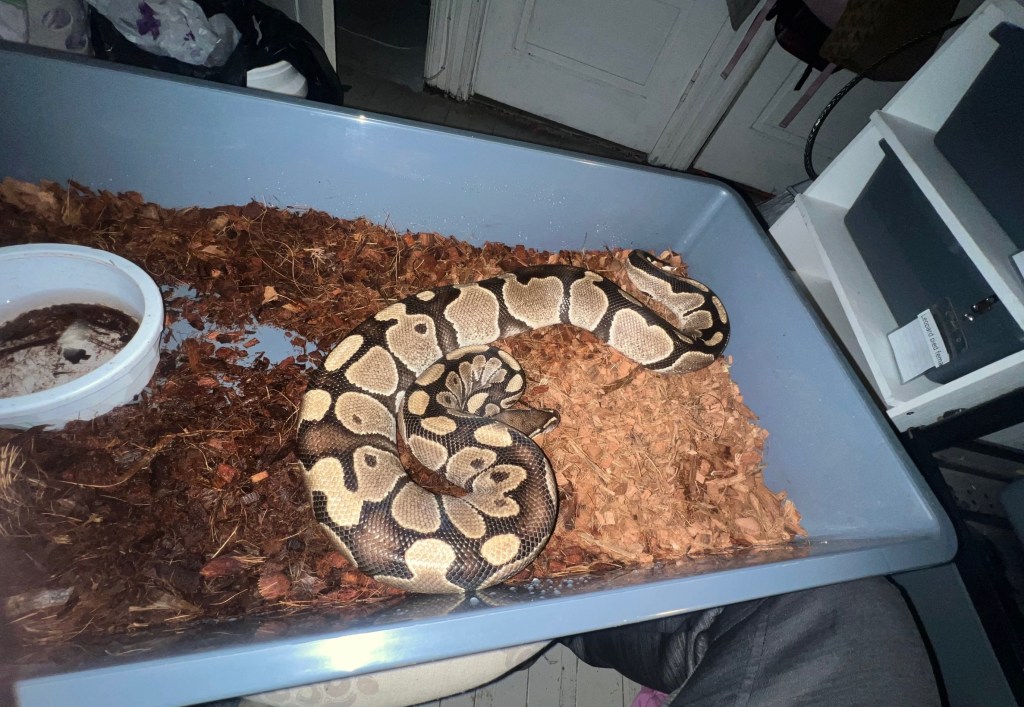
Why is Ball Python Care So Abysmal?

I recently got kicked out of a big ball python group. I joined out of curiosity and was immediately surprised at 1.) How many BP keepers seemed to want to do right by their animals, and 2.) How bad they were at it. I made suggestions, which – of course – got me booted almost immediately.

But because I saw so many really trying I decided to start another “Naturally Keeping …” Facebook group, this one focuses on not only ball pythons, but the other smaller boids and pythons too. In fact, hog-nosed snakes should be kept about the same way as ball pythons, believe it or not.

Ill cover design principles and other important aspects of care in another article. Right now I would like to consider why the standards of care for ball pythons is so low, even among keepers who would like to do better.

I think the biggest problem lies with the breeders. They range from the “up and coming” guys and gals who have a rack in their bedroom closet; to the big factory farmers, aka puppy mill breeders. They all provide similar deplorable care – tubs and racks with zero enrichment – and all defend their animal cruelty with the same dishonest justifications. 

And importantly, they all want to pull their customers into the same pyramid scheme that they are a part of because thats how pyramid schemes work – without a continual crop of new suckers, the boys at the top can not get rich!

The second most important reason why ball python care is so deplorable is that the chain pet stores, and many of the online care sites and videos are pushing products that they profit from. Many to most of the pet store employees and even many of the online guides or youtube videos don’t really know anything about the animals needs or natural history, so their advice is not only skewed toward the profitable, but unfettered by reality. 

If you ask a typical chain pet store employee what all they need for a new pet ball python, you will get a long list of crap, much of which is useless, some of which is harmful. All of which can and should be replaced by the few, relatively inexpensive supplies I will outline on this site. (link coming soon).

Pet store (and Amazon) reptile supplies and equipment are bad news. The exo-terra type cages they sell, and the cages most often available from commercial cage builders, are often overpriced and not well designed. They don’t have tall substrate dams, for example, so they don’t allow for the deep substrate our snakes need. They often have poor ventilation, rather than the offset ventilation they should have. They often do not support the overhead incandescent radiation all herps need. The UV lights sold at pet stores are often the nearly worthless “bulbs” rather than tubes, the ceramic heat emitters and radiant heat panels are often completely unnecessary, as are the expensive thermometers that are often described as “essential”. Even worse are the expensive “bioactive” substrates and bioactive systems that are very likely to do more harm than good. 

So in summary – to avoid substandard care of your snakes, remember to forget everything any breeder and all pet store employees tell you! 

The remaining big hurdle to high standards of care for these ball pythons and other small boids and pythons is a lack of understanding of the animals’ natural history. This ignorance is compounded by the fact that many young people, and a few older people, think that doing “research” for a new pet means reading online care sheets or facebook groups. 

Is not that no good advice can be found on these sites, its just that the noise to signal ratio is incredibly high – lots and lots of bad or confusing information obscuring the bits of good information that is available. The only way for you to know what’s real and what’s nonsense is to understand the natural environment that the species has evolved to occupy, the animal’s role within that ecosystem and how it interacts with the climate and microclimate. 

That’s really the only way to know that when a care sheet or seller explains to you the “perfect” temperature or humidity to keep your snake, you can comfortably call bullshit on him/her. No place on earth maintains a “perfect” temperature or humidity, and our animals are as adapted to the fluctuations in those readings as they are to any one point along the scale. The fluctuations they are adapted to are often important to their physiological functioning and should therefore not be avoided in captivity.

The only way you can really develop this understanding of the animal’s natural history is to read actual books written by people who actually know what they are talking about and to get out in the field and search for reptiles and amphibians. Your personal searches will provide you with a good background for understanding ectotherm strategies for survival. Believe it or not, searching for bull snakes in Illinois will teach you loads about how to keep ball pythons in captivity. 

Books are often kept in buildings called “libraries” that are staffed by “librarians” who can describe to you what a book is and what pages are and how to operate them. With their help you can locate invaluable resources on herpetology in general, and the species you are keeping in particular. Believe it or not, a college level textbook on herpetology is a great tool to have for reference. Even if you don’t understand every word of it (they can get rather technical), you will understand enough to get the gist, and explore other resources for more information. Use inter-library loans to get your hands on high quality, expensive and less common books like Barker’s “Pythons of the World” and others. 

The last thing that I think leads to the abysmal care most keepers inadvertently provide their animals is their own lack of trust in their own abilities to do better. The key element in “doing better” is something many keepers don’t do enough – observe and ask why. Once you set your animals home up, your job – and the fun of owning an animal – is to observe carefully it’s behavior. (This is also why opaque plastic tubs are worse than useless for our animals). What is the animal doing and why? These simple questions will start you down the path of curiosity and empathy, and this path will lead you to the best care rather than the abysmal care so many provide today.

In Summary:

  1. Don’t listen to the breeders
  2. Don’t listen to the (chain) pet stores
  3. Read with skepticism online care sheets and videos
  4. Get familiar with the high quality resources at your local library
  5. Get out in the field and search for local herps!
  6. Understand the basic principles of good cage design (links coming soon)

The Easy, Fast and Effective Way to Treat Snake Mites

There is a lot of confusion and misinformation about snake mites and how to get rid of them. This 5 minute read will explain the best way to attack the problem.

Overview:

  1. Never use no-pest strips
  2. There is no reason to soak the animal
  3. There is no reason to use Dawn dish soap
  4. There is no reason to breakdown your vivarium
  5. You should not use oils
  6. This method will kill your “clean up crew”, which is OK because the clean up crew thing is a myth. They dont actually do anything (See link to more info about this below)
  7. But first: Are you sure you actually have parasitic snake mites and not harmless soil mites?

Let’s cut to the chase: The easiest and most effective way to get rid of snake mites is to use chicken / garden dust containing 0.25% permethrin. You can buy these products online or at the farm or garden stores. Just double check to make sure they contain 0.25% permethrin and not more or less!

This is the same active ingredient in the same concentration as Provent-a-mite at a fraction of the cost. And because it’s a powder, it lasts longer than the sprays once applied.

We will talk about why this works so well and why the other options are either not needed or down right dangerous below. First, lets talk about how to use it.

Simple: Remove the water bowl and turn off any misters, sprinkle the powder over the substrate and on any branches or perches, in the hide boxes, return the water bowl after 24 hours or so. In 10 days repeat. If the infestation is severe you can sprinkle the dust directly on the animal, avoiding its head. 

And thats it! You don’t need to soak the animal, wipe it with oil or otherwise stress it out. The mites will die quickly. 

As an example, I had a large cage – 8x3x3 feet with a 5-6 inch substrate of potting mix, and a layer of “forest litter” leaves and straw on top. The substrate was kept very slightly damp and the cage construction was wood. Some may think that this would be difficult to eradicate mites from, but in fact the simple method I describe here took 10 minutes of my time and about $10 worth of mite dust. The mites were totally eradicated and I had enough dust left over to treat a dozen more cages.

But why does this way work and what’s wrong with the other methods?

Well some of the other methods are harmless but silly. Why on earth do so many people believe that “Dawn” dish soap works better with animals? Its just dish soap people! And dish soap isn’t useful in the treatment of mites. It doesn’t help us.

And some methods are downright dangerous and should *never* be used. No-pest strips are in this category. We used to have to use them long ago when no better, safer options existed. But they are a dangerous neurotoxin that can cause permanent neurological damage to your animals, and WILL have a dangerous impact on you as the keeper. These products are designed to be used in areas that are not occupied by people or animals. They are highly volatile – they seep into every crevice and disrupt normal nerve function. I have been exposed to it. It causes agitation, excitement and nervousness initially, but symptoms get progressively worse from there. There is NEVER any reason to bring these dangerous chemicals – which are banned in Europe – into our homes or collections. 

There is also never any reason to soak our animals or coat them in oil. These stressful practices will not appreciably speed up the eradication of the mites. Mites are very easily drown, so just misting your animal with room temperature water will cause any mites on the surface of the animal to die.

If the mites are numerous on the animal you want them off as soon as possible, so lightly sprinkling the mite dust directly on the animal or spraying with the 2.4% permethrin spray may be called for. The problem of course are the mites burrowed in under the scales and around your snake or lizard’s eyes, may be hard to reach with the dust or spray. If these mites are not killed by the application of the permethrin, they will die as soon as they emerge from feeding, which they must do within 7 – 8 days.

There are other insecticidal treatments for mites as well. These are best left to the professionals. Ivermectin, for example, has been used to treat mites, but it has a number of issues including toxicity to tortoises, so should be avoided by non-professional keepers. (1)

By the way, before you begin treatment for snake mites, make sure your snakes (or lizards) actually have them. Adult snake mites are tiny black dots that you will see crawling around the snake’s body and head. The pre-adult stage snake mites may be lighter brown color, and can resemble soil mites, but they will exist in the presence of the black adult snake mites. If all you see are light brown or whitish tiny bugs crawling on your snake, hold off till you get a positive ID. Soil mites are harmless but their population can quickly explode in vivariums that are too wet, which can annoy the animal and alarm the keeper!

So it’s much easier to treat snake mites if you understand their simple life cycle and what they need to grow and reproduce. This knowledge will help us avoid the ineffective and the dangerous mistakes we see so many keepers make when suggesting mite treatment. 

Snake mites lay their eggs in humid areas. The larvae that hatch out need at least 75% humidity in order to molt into second stage nymphs (protonymphs). Below 75% humidity they desiccate and die. These larvae do not feed before molting into protonymphs, which do parasitize animals.

The protonymphs feed on the snake or lizard hosts:

“Unfed protonymphs often congregate on inanimate objects within the cage and swarm onto any source of disturbance including, cleaning utensils, the caretaker’s hands, or the cage occupant. Upon contacting a suitable reptile host, protonymphs quickly crawl either under scales or around the eyes, attach and commence feeding. Attachment to complete engorgement requires 3 – 7 d at 25°C (77°F). Newly engorged protonymphs drop from the host and congregate on rough surfaces within the cage that are protected from light.” (2)

So its important to understand that these protonymphs feed, then leave the host to digest their meals. When they do they inevitably come in contact with the mite dust we have sprinkled on the substrate and perish. This is one of the reasons we want to use the dust rather than the spray – I believe, but havent seen conclusive evidence – that the dust will remain effective longer than the spray, which *may* breakdown faster in the environment. Of course using both in tandem – with the spray directly on the animal and the dust for the cage – may be advisable with heavy infestations. 

But at any rate, these protonymphs molt into deutonymphs, which dont feed but like the adults crawl all around the cage. Again, it is this exploratory stage that works in our favor since this is when the bugs will come in contact with the permethrin powder and die.

You can keep mites from spreading by simply sprinkling the mite dust around the cage that you see the infestation. But keep in mind the mites may have already migrated to surrounding cages, so be prepared to treat others, or possible all eventually. Consider using the mite dust prophylactically on nearby cages before the mites get established. After 3 or 4 weeks go by with no mites, you can rinse any remaining dust off the substrate, plants or other cage furnishings.

Now, for those of you who have isopods, springtails or other “bugs” in your bioactive vivariums. You will be relieved to know that these bugs actually do no good at all for your vivariums. And yes, I know you have been told otherwise. But they don’t. The natural bacteria that is in and on every substrate is more than sufficient to break down animal waste, and in fact will do so much more quickly than any bugs will. And fungus is not consumed in any noticeable way by springtails. There are side-by-side comparison videos available to prove this in my FB group: naturally Keeping Reptiles and Amphibians.

So feel free to use this method should snake mites infect your animals, and free yourself from the myth of clean up crews too! Its a win-win.

So where did your mites come from? 

As pointed out in Mader, one common source may be live feeder mice from pet stores

“Food items such as live mice have also been incriminated in transferring snake mites into collections. Pet shops often maintain rodent cages near snake cages, and when the snakes have mites, they often get into the rodent cages. Thus, an unsuspecting owner may carry home mites with a live prey item. 

Freezing prekilled rodents appears to eliminate snake mites; however, freezing is not effective for eliminating pathogenic bacteria or protozoans. “ (3)

So to wrap up, it’s really quite simple to get rid of snake mites. Many of the remedies you find online are not helpful, some are dangerous. Dont soak, dont use oils, DO NOT use no-pest strips. Do use 2.5% permethrin chicken / garden dust as described in this article. 

  1. Teare JA, Bush M. Toxicity and efficacy of ivermectin in chelonians. J Am Vet Med Assoc. 1983;183(11):1195–1197.
  2. Journal of Herpetological Medicine and Surgery, Volume 10, No. 3 and 4, 20000
    The Biology, Clinical Significance and Control of the Common Snake Mite, Ophionyssus natricis, in Captive Reptiles
    Edward J. Wozniak1, DVM, PhD, Dale F. DeNardo2, DVM, PhD
  3. Mader’s Reptile and Amphibian Medicine and Surgery. Divers and Stahl, ElSevier 2019

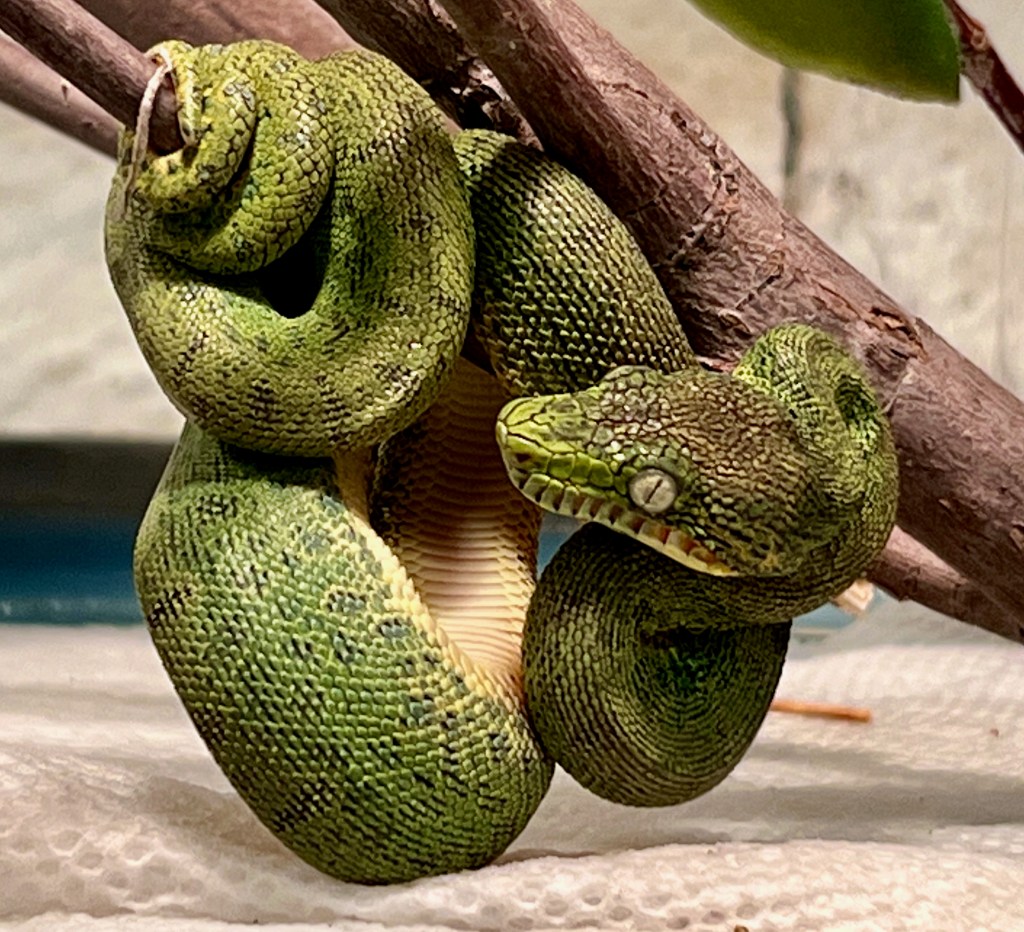
Are We Wrong about Humidity Requirements for Emerald Tree Boas and Green Tree Pythons?

Debate continues around the humidity requirements of green pythons and emerald tree boas. In part, I think, because there are some misunderstandings about the role of humidity in the snakes’ physiological functioning and the various ways we keepers try to maintain proper levels.

When we have a snake that doesn’t shed well we tend to attribute that to humidity being too low. And keepers may be advised to increase humidity by adding a misting system, or shutting down ventilation. However, like all our herps, these species need fresh air, so closing ventilation isn’t a good idea. And misting systems tend to spike humidity levels and then, when turned off, allow levels to return to normal, low levels. 

“Excessive humidity and temperature also promote fungal replication and sporula- tion so that exposure to fungal spores may reach a magnitude that will overcome the reptile’s immune system.” (1)

In fact, its questionable if high humidities are needed at all with these species. Keepers seem to think that because the snakes are from tropical environments, we need to recreate tropical humidities in our enclosures. The concern maybe that the snakes will dehydrate in lowr humidities. And by low humidity I mean 40-50%, not 10 or 20%

Dart frog and other frog keepers also assume this to be true, and as a result will soak their cages every day till the frog’s toes rot off and they die. Even after they see this happening they have trouble changing their ways. And even after I built vivariums that I only lightly misted every 7 or 10 days – which, by the way, more closely imitated the frogs wild habitat – the frog keepers refused to even consider it. Most got upset and yelled at me for even suggesting it.

So our herp myths run very deep! We must keep green pythons and tree boas at high humidities, or else! Or else what? A snake’s skin is almost completely impermeable to water. No water gets in or goes out through their skin. And of course they dont sweat. So why are we misting them? Why are we depriving them of something we know they need – fresh air – to ensure they get something we don’t know they need – high humidity.

There is no doubt that a snake will lose more water respiring in a dry environment than they would in a humid one. But how much? Keeping in mind how few breaths one of these snakes takes per minute, is it likely they would suffer any appreciable increase in water loss from 50% humidity to 80 or 90% humidity? And even if so, wouldn’t that loss be recovered just by drinking?

Like all animals, our snakes have to stay hydrated in order to maintain proper osmotic pressure in their bodies fluids. As they loss water and start to become dehydrated, their cells, kidneys and other organs lose their ability to function and toxins start to accumulate. And because its a potentially lethal condition, animals have developed a lot of different ways to minimize the likelihood of it occurring – mostly thru behavioral adaptations, and thru physiological adaptations. 

This is an important point, because while some of the adaptations that allow the animals to deal with the stress of dehydration kick in quickly, others take time to develop.

So, that would mean misting may be doing more harm than good! If we mist the cage every day at noon, the snake may be in the process of adapting to the higher levels of humidity just as the humidity levels are plummeting back to their normal lows. 

The question then becomes more about the range of humidities the snakes can easily adapt to. After all, why would a snake from the tropics develop water saving strategies? But in fact all animals seem to have the ability to take protective internal measures against dehydration.

Lizards, for example, can change the permeability of their skin in response to humidity changes, but it takes time – 24 hours in one study.  Most frogs can resorb water from their urine and convert their waste to uric acid, thereby staving off dehydration.

But if any similar water saving processes are at work in our snakes, and they most certainly are, maybe we are short circuiting them by too quickly switching things up before they have a chance to adapt?

“A number of hormones function to control salt and ion regulation in amphibians and reptiles… many of these hormones are similar in all vertebrates. Certain hormones are rapidly released in response to an immediate threat, such as dehydration, whereas others are involved in long-term acclimation processes that ultimately reorganize cells and tissues and increase transport capacity. (1)

Maybe what we should be recommending is that we get the snakes established and settled in first. This means very well hydrated via rain system  or heavy misting or a big bowl of fresh water – maybe with a gentle aerator in it. And then give them time to gradually adjust to the lower humidities of our temperate homes.

What we should avoid is jumping to conclusions based on those first couple weeks. Maybe we are too quick to blame the “overhead halogen” which is very beneficial to almost all herp species, when we see a rough shed. After all …

“The highly impermeable integument of reptiles permits direct exposure to sunlight without excessive water loss.” (2)

Often keepers are advised to mist more frequently when they see their snakes are ready to shed. But when we wet the snake’s skin by misting or spraying, the water softens the skin and causes it to more easily tear as the snake tries to shed. Instead of a nice clean shed, this can result in the same sort of mess we see when the snake tries to shed in an environment that’s too dry. 

Moderation and time to adapt may be what we are missing.

Conclusions and Recommendations

Often snakes will choose security over preferred temperature. They may refuse to eat and presumably even drink when their access to prey or water requires them to compromise their perceived security. This is why larger, more environmentally stable enclosures that offer the snake a wide range of security gradients + temperature gradients + humidity gradients are best. Dont require that your snake abandon its “prime objective” which is security in order to feed or drink or find proper temperatures. The small, barren cubes we see popular in the hobby are a poor option for our captives.

The great thing about decreasing misting is that with less water being applied, we can use a deep substrate of quality potting mix, along with a layer of “forest litter” on top. And we want to do this because the slightly damp potting mix slowly releases water through evaporation, which provides a steady supply of moist air that will bring humidities up to that 40 or 50 or 60% level that we want even with good, offset ventilation.

A warm overhead halogen set up on a WiFi dimmer / timer is still the best option for heating. I dont doubt that animals have been overheated by these lamps, but thats a design flaw, nothing inherently bad about this helpful and important radiation. The enclosure should have a large number of *natural* branches that criss-cross the cage left and right and again top to bottom. The snakes should be able to find suitable temperatures and security in all parts of the cage. The 2 or 3 PVC “sticks” that cross the cube cages perfectly horizontally is not something we want for our snakes.

So there you have it. Instead of the sad small cube cages with PVC perches and baby diapers for substrate that we mist madly every day in a desperate attempt to keep the humidity up, lets try a different paradigm:

Larger, horizontal cages with deep, slightly damp potting mix substrate providing continual, gentle humidity that the animals can adapt to. Lots and lots of natural branches that criss-cross the cage. Fake or real plants that provide overhanging security and protection over some, but not all of those branches. Bowls of *fresh* water, possibly initially with a gentle aerator air stone to cause movement and attract the snakes attention. And then TIME. Time to watch and learn, time for the snake to adapt to its new environment, and time for you to figure out what you need to change to provide them with what they need.

  1. Infectious Diseases and Pathology of Reptiles. Jacobsen, 2007 p. 548
  2. Herpetology: An Introductory Biology of Amphibians and Reptiles 4th. Vitt and Caldwell, 2014 p. 168
  3. Ibid p. 208

Further Reading

Tu MC, Lillywhite HB, Menon JG, and Menon GK. 2002. Postnatal ecdysis establishes the permeability barrier in snake skin: new insights into barrier lipid structures. J Exp Biol 205: 3019–3030.

PARATHYROID GLANDS, VITAMIN D3, AND CALCIUM HOMEOSTASIS: Mader’s Reptile and Amphibian Medicine and Surgery. Divers and Stahl. p. 987

Agugliaro J, Reinert HK. Comparative skin permeability of neonatal and adult timber rattlesnakes (Crotalus horridus). Comp Biochem Physiol A Mol Integr Physiol. 2005;141(1):70–75.

Why Hybridize Eastern Indigo Snakes?

1. What Are We Protecting?
2. The Benefits of Hybridization
3. The Fears of Hybridization

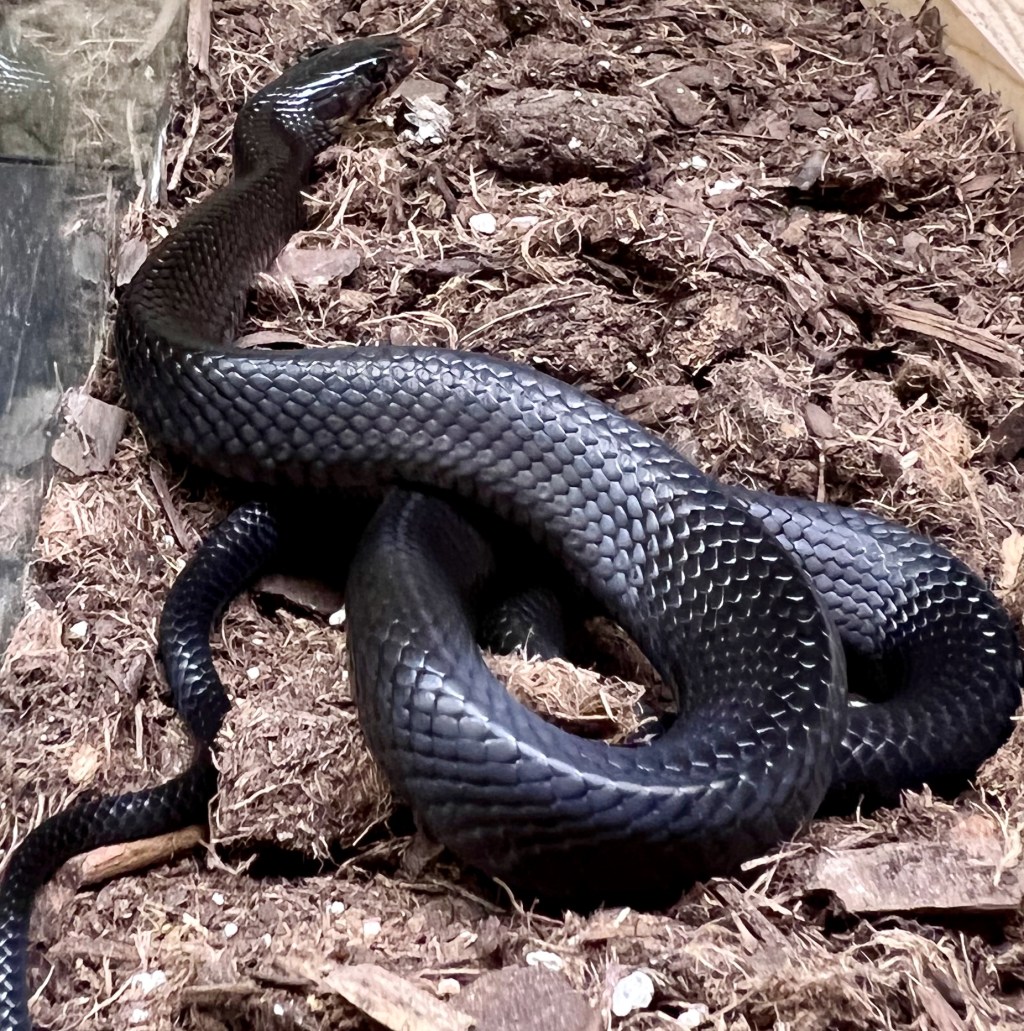
There is a lot of concern over my plan to produce hybrids from Eastern indigo snakes (Drymarchon couperi) X Texas indigo snakes (Drymarchon melanurus erebennus). I want to explain why it’s a good idea to do so and alleviate some of the concerns that people have expressed. 

First, it has to be noted that a good deal of the concern over this hybridization plan comes from those who currently breed Eastern indigo snakes and are simply afraid of losing sales. And some of these guys are quick to misinform inexperienced acolytes with unlikely scenarios who then go forth and spread their gospel. 

Second, for those who have accused me of selfish motives, I want to publicly state that every penny earned from this project will be donated to The Nature Conservancy’s Eastern Indigo habitat restoration project in the Florida panhandle. And that will continue for as long as I’m alive. Buying one of my hybrid offspring will be a direct 100% donation to Eastern indigo conservation!

But even ignoring the yahoos, legitimate concerns can still be expressed over this hybridization plan, and thats what I want to address here.

What Are We Protecting?

It’s important to understand that DNA analysis has been done on hundreds of eastern indigos in both the US and Europe. This work was initiated and paid for by a particularly passionate keeper on the East Coast with the initials AB. (I never know whether he is OK with my mentioning him, but most long time keepers of Drymarchon know hs work well.) 

What this analysis has shown is that the eastern indigo snakes currently in captivity are indeed seriously inbred. In fact, very many of the snakes in the US and Europe descend from Robert Bruce’s less than admirable efforts. Mr. Bruce is probably the largest producer of Eastern indigos in the world and has openly advocated inbreeding D. couperi for decades. He is also known for the deplorable way he keeps his animals – but I digress.

So just to start the conversation we have to ask ourselves what is it we are trying to protect when we object to the hybridization of the eastern indigo snake? Is there any merit in protecting the inbred genetics of the current Easterns in captivity? What is the point of keeping “pure” the cluster fuck of genetics that we have in the captive gene pool today? What purpose would that serve?

None what-so-ever? Im glad we agree.

In fact, the vast majority of producers to date have shown zero interest in protecting the wild-type genetics that existed in the captive population back in the 70s when new blood was first cut off by laws protecting wild populations. So why is it suddenly important to “protect” the genetics that most of today’s producers were instrumental in mucking up in the first place? Seems a bit hypocritical, doesn’t it?

The Benefits of Hybridization

When you think of it, how uncool is it to continue to breed a species that you know is being destroyed by inbreeding? Isn’t there something at least negligent, if not down right cruel, about producing more baby eastern indigo snakes knowing that the vast majority of them will end up in hands of keepers who will not care at all about the genetic problems the captive population faces?

I think thats the real problem. Not the fact that someone is trying to relieve the genetic stress on the captive species through hybridization, but that so many have recklessly disregarded their contribution to it!

Whether producing hybrids of these species is good or bad depends only on the readers understanding of the problem and the potential solutions. The simple, unavoidable truth is that genetic inbreeding will continue to deteriorate the health, life expectancy, hatchling morbidity, and morphology of eastern indigos. We can debate what traits are actual evidence of inbreeding, but the fact remains that inbreeding destroys genetic viability over time. What is less well understood is that at some point, there simply isn’t enough genetic diversity left in a population to recover the species. There is educated speculation that the captive population of easterns has passed this point of no return.

But what if it hasn’t? What if it were theoretically possible to save it? If recovery were still possible it would take a big effort! Existing captive snakes globally would have to be located, documented, have their DNA analyzed and have that data entered into a global database.

Then breeders would have to agree to forgo breeding their snakes if they proved to be closely related. Others would have to agree to swap out their snakes with other breeders. The DNA of offspring would then have to be analyzed and the babies redistributed to others depending on their relatedness. And the process would have to continue for many generations and never allowed to reverse.

Needless to say, this aint happening. There is already *very* little concern over the inbreeding problem. I sold a group of hatchlings last year and only one of the buyers even asked about genetics. The big producers make little or no attempt to restrict sales to people who they suspect may inbreed the snakes. In fact some of the biggest breeders are happy to sell you siblings, knowing full well they will be bred in 3 or 4 years down the road.

Clearly the “pie in the sky” solutions for recovering the captive population are delusional. We can dismiss them.

So the benefit of hybridization is that it would infuse the eastern indigo captive population with the fresh genetics that we otherwise do not have access to. It would pull the captive population back from the edge of the DNA cliff. Hybridization has the potential to create big, healthy indigos of a range of colors and personalities. With time they could be very similar to easterns in every way. Or they could exhibit the best of the Texas animals.

As an aside, it should be noted too that hybridizations between Easterns and Texas snakes and other subspecies of Drymarchon have already taken place and has been successful. We have D. m. melanurus and D. corais hybrids for example. And D. couperi and D. m. rubidus hybrids. And of course we have the “accidental” Texas and Eastern hybrids. All of these already exist. The hybridization train has left the station.

The Fears of Hybridization

Other than the hysteria promulgated by those Eastern indigo producers who stand to lose market share, there are some real concerns that have been voiced that deserve a response. 

The biggest one is the potential for mistaken identity. How will people know they are getting a “pure” eastern indigo rather than a hybrid? Wont adding more hybrids increase the potential for mistakes or fraud?

Well, remember that today you really dont know if you are getting a pure Eastern or not either. One of the most respected distributors of indigos has been accidentally selling hybrids, for example. Buyers who ended up with those babies will surely breed them – and offspring may well go on the market as pure easterns. One buyer even promotes his snake as unrelated to others in the hobby because its DNA analysis shows it shares less DNA than most others! Instead of admitting he has a hybrid, he’s promoting it as an asset!

Hybrids exist in Asia and its safe to assume their offspring will make their way back to the states soon enough – properly described or not. The albinos in Europe will present yet another challenge.

So how much better to have a legitimate hybrid market, where keepers would not be embarrassed to offer their animals for sale? Legitimizing hybrid production will serve to reduce the likelihood of fraud or mistaken identity. It is an important point that people seem to miss.

The truth is, hybrid Easterns are likely to retain morphological traits from their Texas ancestry for many generations. But what if they dont? What if an eastern hybrid looks so much like a wild type that it is indistinguishable? Then so what? What is the problem here? That the captive eastern genetics will be messed up? I hope the reader sees by now that that fear is unfounded. There is simply no such thing as a pure eastern indigo in the hobby today. The genes are already completely corrupted thru selective breeding and inbreeding. There is no “pure” left to worry about! 

Second, there will always be breeders who pride themselves in maintaining pure Eastern indigos, and pure Texas indigos. That’s the way our hobby works. Just like there are breeders who are careful to produce the locality king snakes I recently bought. So anyone who insists on enduring the federal permitting process for a pure animal will be free to do so. The act of producing hybrids does not cause the extinction of the pure stock.

The final concern is about conservation and the release of hybrids into the wild. As most of you know, the conservation of the species relies in no way on the captive population currently in hobbyists hands. Professionals are very well aware of how badly we have screwed up this captive population, and they would never, ever, *ever* use a snake from the hobby to produce offspring destined to be released. 

And as for the accidental release of hybrids, the exact same threat exists from pure Texas indigos and pure Eastern indigos. Releasing a hybrid Texas indigo into the Eastern indigo range would be less harmful than releasing a pure Texas snake. So hybrids would actually diminish this threat. Although I have to say, it’s a very small threat to begin with. The idea that someone would take a valuable Texas indigo and release it into the Eastern range is just highly unlikely. It doe not amount to a legitimate concern.

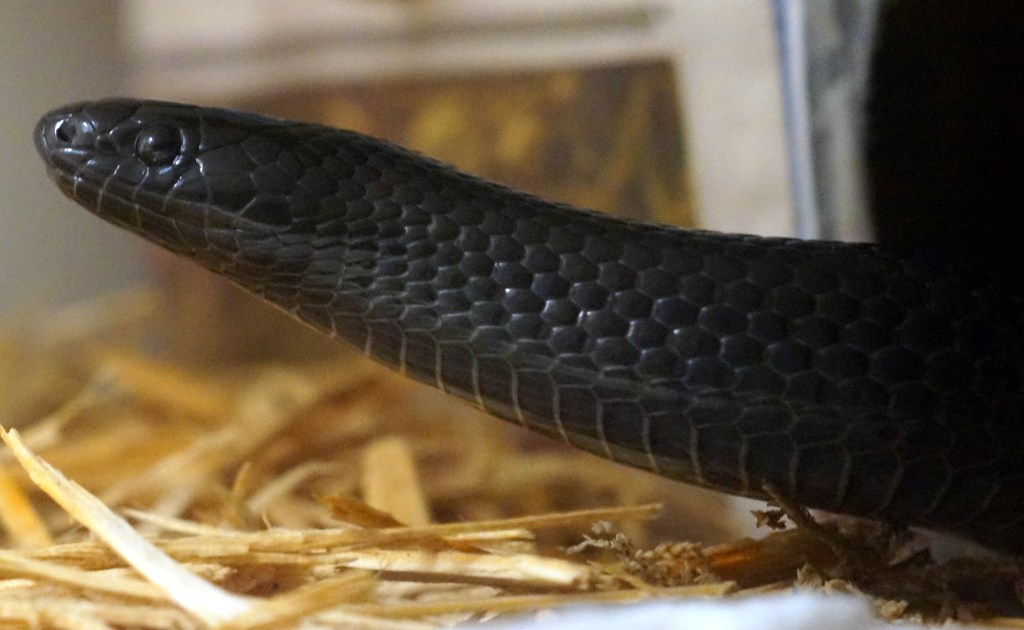
A young Texas indigo in an enriched vivarium.

The Herp Hobby 2.0 is Coming … Many are not gonna like it.

There is some understandable terror rippling through the herp business these days. The reaction to my last post on the subject made me realize the fear has caused some to lash out, some to “see no evil” and some to ask legitimate questions. I want to take a stab at answering those legitimate questions here.

First a couple quick things. I take no joy in watching people suffer. I know we are heading into a very painful time for many in the business. I don’t wish financial or any other kind of harm on anyone. People get confused about this because I find it impossible to hide my excitement about the business reverting to the hobby. Im thrilled that we will once again see the hobby I knew in the 70s, 80s, 90s and very early 2000s. I realize that for the majority of folks the herp *business* is all they have ever known. The majority have never experienced the hobby when it wasn’t hyper-inflated. The fear of the unknown is understandable.

I’m also thrilled that the know-nothing show off “influencers” who have presented themselves as experts on youtube, etc will be fading away. I hope their demise is quick and I hope the pain they experience is directly proportional to the degree of the idiocy they exhibited. Sorry, thats just me.

As we watch this slow motion disintegration of the herp business a number of good questions have come up. First though, lets dispel any mythical wishful thinking that the “market is in a slump” or that this is a “cyclical correction”. This is whistling past the graveyard. It doesn’t even resemble reality. Inflation is down, unemployment is down, consumer confidence is up. Markets don’t decay away in these economic conditions unless there is rot at the core.

This hyper-inflated herp market was built on lies and greed and speculation. It has been a classical pyramid scheme, and it is collapsing as pyramid schemes always do. If you arent sure exactly how pyramid schemes work, do yourself a favor and look up the “Tulip Mania ” speculative bubble from the 17th century. That historical economic roller coaster ride will provide you with a road map telling the future of the herp business.

And second, let’s dispel the myth that I am predicting the end of the herp hobby. I’m not. There will always be the “hobby”: passionate keepers who have a fascination and respect for their animals, who provide top quality care, and who occasionally have a few offspring to sell to others. And there will always be suppliers of related goods and feeders that profitably support the hobby. There will always be kids who talk their parents into buying them a snake, or lizard or frog from the pet store. And there will always be kids who drag their parents to the herp shows, although they will be vastly fewer and the smaller ones will eventually have merge with the aquarium, bird, and/or exotic pet shows in order achieve profitable attendance levels.

And, thank god, there will always be new, passionate keepers who enter into the hobby for the right reasons and who will remain a viable market for the surplus animals other hobbyists produce.

The valid questions that I have received include these: If we are seeing the collapse of the herp business, why are there still many sales? Why are some species still expensive? Why are we not seeing shows closing? And for that matter, how can anyone predict the “collapse” of the whole herp business?

Brief but important background: From my observations over the years, the ball python market started to accelerate about the year 2000, although slowly at first. I remember the moment I knew something had changed: the Tinley Park show in 2000. That was the first I had heard of people buying any herps because they could make money on them. It seems absurd now looking back on it. But 90+% of us herp hobbyists never considered making money off our animals. But on this day the owner of Prairieland Herps, who I was buying a pair of Russian rat snakes from, told me that everyone stops by his table to tell him how cool his snakes were, and then they go over and buy ball pythons.

This was surprising to me first because the ball pythons I had known up till then were ugly, tick infested, skinny, reluctant feeders, most of whom were destined to quickly die and that sold for $5.00 from the importers. I had a lot to learn.

Within a couple years the hobby became infested with “investors” who followed along greedily with the “get rich quick” schemes. The entire nature of the hobby changed as hobbyists were replaced with business roaches. Once beautiful, respected and fussed over animals became nothing more than livestock. Their care was continually minimalized until it was little more than the abysmal rack and tub systems that supported the speculative lunacy.

“Look how cheaply you can keep these guys!” the hucksters would exclaim. “Why, you can squeeze 100 snakes into a single rack that takes no more than 3×3 square foot! You can make a mint raising snakes in your closet!

And of course the idiocy spread to a few other species that could be abused with minimal care and unloaded on other naive business start-ups. It’s important to keep in mind that the important factor that drove this explosion was the investor – the speculator, the drooling business tycoon. NOT the hobbyist.

These business geniuses had FAITH that the irrationally exuberant market would continue at least long enough to convince others to buy in – to get religion and spread the good word. This new religion had its well known prophets, had its disciples, and had its ardent followers. Thus the pyramid scheme was born!

Its important to understand this point. The herp boom rode on *faith* not market fundamentals. And just like the crisis of confidence that motivated runs on banks that preceded the Great Depression, herp buyers have now lost that faith.

So the big questions: How low will the market go, and why hasn’t it already gone there? (I understand that the easiest way to look like a fool is to attempt to predict the future. But I have 50 years of experience so I have as much right to make a public fool of myself as any, and fewer inhibitions about doing so).

When markets crash they always dip below what is “normal”. The herp hobby wont be an exception to that rule. Certainly many, many animals will become worth less than nothing. Meaning they will have to be housed, fed and kept warm even when there is no prospect of selling them or their offspring at any price. And this will initiate a real tragedy of neglect, abandonment and release. A wave of abuse that will promote legal remedies all over the country. We’ll get the hobby we deserve in other words.

Again this doesn’t mean all sales will suddenly stop. Just that the business will become unprofitable – a waste of time and money. As I said elsewhere, 70% of the herp shows will close up shop. And those that remain will be selling a fraction of the animals and supplies they normally would. Mid sized breeders will vanish, big name breeders will too. Overhead will far outstrip income even when time isnt fairly calculated.

So the big questions many have now – and they are good ones: Why are we not seeing sales plummet across the board? Why are shows still open? Why are some species still expensive?

The simple answers are two: First, the market for herps is small and so can be manipulated by a small number of colluding producers and importers. Working behind the scenes, even a small number of people can work to create new, short lived bubbles, or work to fool the buying public that the market for some species is still strong.

If you look at the recent attempts to create speculative bubbles for rainbow boas or tokay geckos, for example, you can see this illegal activity well underway. Or if you look at the prices for western hog nose snakes you will see breeders trying to present the facade of a strong market in the absence of one. In short, prices for these species are sticky due to manipulation. But when the faith is lost, their prices will tumble fast and far. Hog nose snakes will be selling for less than half of what they are today by next New Years, as an example.

Another factor in the slow motion crash is that the bubble breeders are floundering around trying to get in on the bottom floor of the next big pyramid scheme. So they are creating minor support for whatever species is rumored to be the “next big thing”. Only there wont be any next big thing.

The reason why this collapse is slow moving is simple: there are no public indices of the collapse. No news headlines, no market graphs showing clear, steep declines. No on air analysts explaining whats happening. So there are many who just dont know. Many others who know but will not say because doing so will only hasten the collapse. And many others who will lie, hoping to fool someone – anyone – into freeing them from their growing financial burden.

My last post on this topic was shared with a few other groups and by a few other people. I encourage this because I appreciate the feedback. But what I saw was a lot of denial, a lot of anger, a lot of whistling past the graveyard. And a lot of misplaced anger toward me, the messenger. But I can guarantee you one thing: Even the loudest of my critics are feverishly unloading whatever they can, whenever they can and wherever they can.

No-one wants to be the fool left holding the bag.

The important thing to understand about a speculative bubble is that it runs on faith, not facts. And the masses have lost the faith. There is no way to get that back. Its gone for good.

Working Groups for Reptile and Amphibian Standards of Care in the US (draft)

Introduction

The Facebook Page is here for more info:
https://www.facebook.com/profile.php?id=61555253836773

In general humans seem to be increasingly concerned over the quality of care we provide our pets. Even improvements for livestock care are being mandated. It’s certain that this trend will continue, and it’s certain that it will increasingly impact our reptile and amphibian hobby. rather than have an animal rights organization, or a government authority design and proscribe new laws, why not call on the education, talent and experience within the herpetoculture community to develop guidelines? When the call for laws comes around – and I think it will sooner rather than later – we will have a well researched set of detailed guidelines that can guide the creation of those laws.

Our hobby has recently experienced an interesting divergence of paths. One the one hand, we have seen an amazing elevation of care and products manufactured to provide that care. Research and the dissemination of the knowledge gained by experienced keepers has spread across social media.

But along with that ease of communication comes a great deal of misinformation. As we see with the social media “influencers”, anyone with a computer and an internet connection can claim authority, regardless of their knowledge or experience. There is no peer review.

A well referenced standards of care document would help eliminate much of that disinformation if it was produced by those whom the community trusts. In this case the “community” meaning both the advanced hobbyist and the professional – biologist, zoo keeper, academic, etc.

The other path the hobby has taken is one that has reduced our pets to livestock. These are the big and wanna-be big breeders who have reduced care to its bare essentials in order to increase profits. Their goal is to eliminate any cost that isn’t required for the survival and reproduction of the animals.

This path became more prevalent as people came to believe they could make “easy money” breeding ball pythons, bearded dragons, crested geckos and other species. These became “bubble species” whose price quickly spiraled up as demand grew. And predictably, as demand collapses, the price they bring will spiral down faster and further than other, non-bubble species.

Sadly, the animals that once promised to bring profits are now costing their owners real time and money, with no prospect of recovery. What this means for the animals is further abuse, neglect, and death. Many will be released where they may upset the natural balance, but most will succumb to starvation, predation or the elements.

I believe that a high quality, collaborative document created by professional and advanced amateur keepers that outlines Standards of Care will enhance the well being of the animals and reduce their exploitation for financial gain.

Guiding Principles

Guidelines for the care of exotic animals in captivity should be informed by the animals natural interaction with its habitat in the wild. Enclosure designs should reflect the natural elements that support the species relationship with the natural environment. This doesn’t mean that the enclosure should mimic nature per se, nor does it exclude artificial elements in the design.

What matters is that the species recognizes and interacts with the captive design elements as they have evolved to interact with corresponding natural elements. An arboreal snake should have ample opportunities in captivity to engage in climbing, and that climbing should be sufficiently similar to natural climbing that the animal easily adapts to it.

Animals that burrow, or live in burrows should be provided a substrate that facilitates burrowing, or the creation of artificial burrows. Animals that bask, even occasionally, should be provided basking opportunities from sources that correspond with important wavelengths of radiation. The unnatural, far infra-red radiation produced by radiant heat panels and ceramic heat emitters would not suffice as basking sources, for example. Although they could be useful in some circumstances to raise ambient temps.

Although cage size is often emphasized in captive care guides, it is not in itself as important as cage design. The benefits associated with larger cages are often negated by poor design. While smaller cages can be greatly enhanced by thoughtful designs carefully created by knowledgable keepers. Even so, a minimum set of dimensions should be provided just to give keepers an understanding of species needs. People buying baby iguanas, anacondas or monitors would be benefitted by these minimum guidelines.

Benefits of Standards of Care Guidelines

Many people cringe at the idea of increased regulations and I share some of their concerns. We all know of cases of over-eager enforcers not using common sense or understanding. But that fact doesn’t negate the benefits of legally binding guidelines.

The vast majority of the disease or injury in captive reptiles and amphibians is the result of inappropriate enclosure design or inappropriate nutrition. And advice on how to correct these mistakes is often as wrong as the initial conditions. By providing high quality, yet reasonable guidelines to the keeper, the animals well being would certainly be improved. But also the non-exotics veterinarians would have a useful reference from which to begin an exploration of cause and cures. Wildlife officials from conservation officers to animal control officers would have a reference to consult when assessing the care a keeper is providing.

Lawmakers too would have a reasonable and thorough reference, created and maintained by expert keepers, exotics veterinarians, herpetologists and others who have skin in the game. This would be useful for countering any of the too-restrictive or irrational proposals from people or groups that do not have a deep understanding of the animals and their needs.

Finally, by producing and following carefully developed guidelines, the hobby will begin to craw out from under the nasty reputation it currently has due to irresponsible keepers, irresponsible YouTube “influencers”, large scale factory farmers, wholesale producers and retail chains that habitually sell animals to customers who are unknowledgeable or unable to provide proper care.

Shall We Kill Invasive Wildlife?

Killing invasive wildlife is almost always a political act, not a biological one.

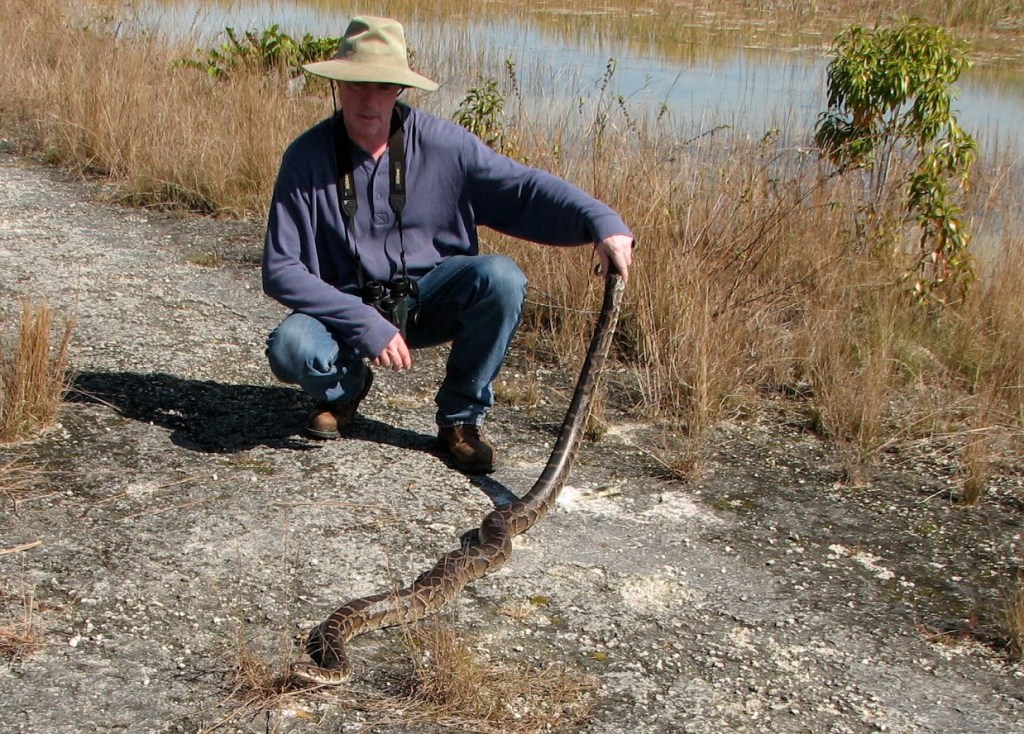
Im annoyed by the people on Reptile ID groups, and elsewhere, that advise people who post pictures of cuban tree frogs, basilisks, Burmese pythons, or other non-native species to kill them.

These are almost always people with zero experience, or worse, wildlife rehabbers, who seem desperate to assert their authority over others by informing them of the Proper Coarse of Action. They jump at every opportunity to state with great authority that the non-natives are destroying native species and, as I heard yesterday, that every invasive species that is not immediately killed will “produce tens of thousands of offspring” – as if anyone who doesn’t take it upon themselves to kill some hapless little frog they discover in their yard is guilty of horrendous crimes against nature.

These wildlife police don’t seem to be able to comprehend the fact that, for example, 99.9% of the frog eggs laid will die of any number of natural causes before they reach reproductive age. And that killing one simply makes room for one more of those eggs to survive to adulthood and fill that space they created.

They never seem to question whether the non-native species is *really* destroying the habitat or out competing native species. They are too eager to lord their Deep Insights, Superior Understanding and Authority over others to be curious about the facts they hold dear.

Its like the park conservation officer at a state park in the Florida Keys who explained to me – pointing at the beautiful, non-native blue and orange agama hanging on the side of a tree – that they were bringing in a trapper to rid the park of these invasives, and the beautiful green iguanas we saw along side the path too. I asked her why and she explained that they upset the balance of nature and pose a serious risk to the native wildlife and ecosystem.

At the time, we were standing amidst a crowd of park visitors who were gathering at the beach, raising our voices over the rumble of a dozen boat motors spewing exhaust smoke at the docks, and surrounded by literally hundreds of cars swirling around on two huge asphalt parking lots.

I didn’t respond immediately to her comments but instead slowly looked around at our surroundings. Then looked at her and asked, “So it’s these little lizards you see as the problem?”

If photos of these little lizards had been posted to one of the Reptile ID groups, the nazi know-nothings would have advised all reading that they should die. And that the poster had a responsibility to capture and kill them. In order o ensure the balance of nature not be further disrupted by their bright blue and orange presence.

I really, really hope that these self appointed wildlife nazis take a breath and realize they have no right to be advising anyone to be killing anything. They are promoting violence against wildlife in a sick and irresponsible way. Without even understanding what they are saying or why, they are insisting you and I and everyone else adopt their psycho, uninformed, utterly senseless and stupidly violent attitude toward nature because, dammit, *they* get to decide what wildlife gets to survive and what doesnt.