I recently got kicked out of a big ball python group. I joined out of curiosity and was immediately surprised at 1.) How many BP keepers seemed to want to do right by their animals, and 2.) How bad they were at it. I made suggestions, which – of course – got me booted almost immediately.
But because I saw so many really trying I decided to start another “Naturally Keeping …” Facebook group, this one focuses on not only ball pythons, but the other smaller boids and pythons too. In fact, hog-nosed snakes should be kept about the same way as ball pythons, believe it or not.
Ill cover design principles and other important aspects of care in another article. Right now I would like to consider why the standards of care for ball pythons is so low, even among keepers who would like to do better.
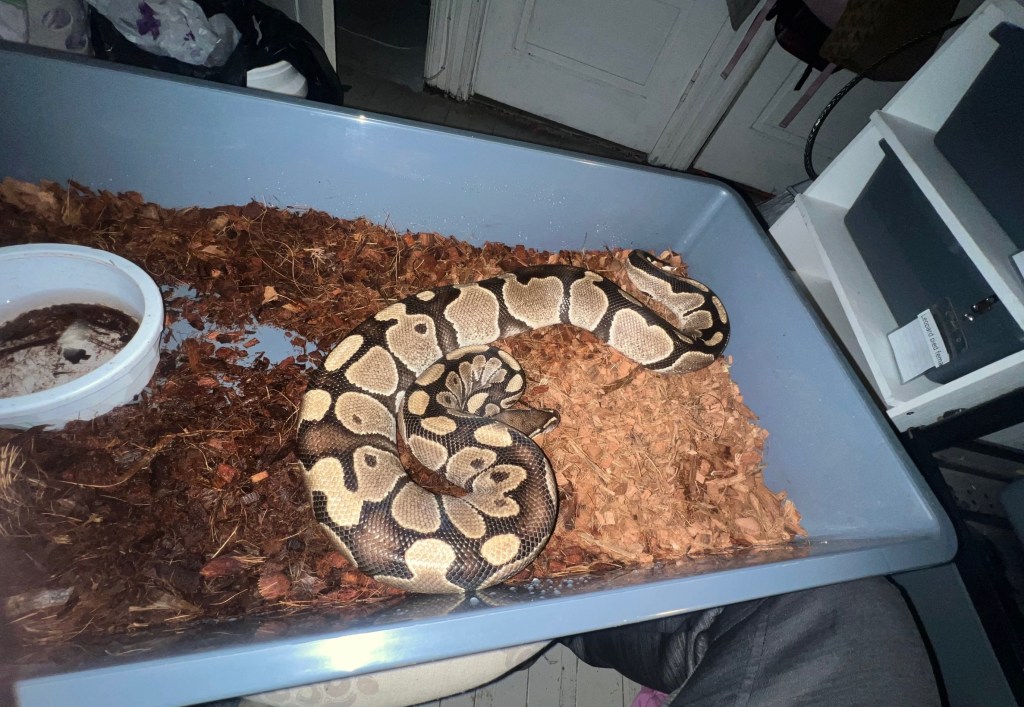
I think the biggest problem lies with the breeders. They range from the “up and coming” guys and gals who have a rack in their bedroom closet; to the big factory farmers, aka puppy mill breeders. They all provide similar deplorable care – tubs and racks with zero enrichment – and all defend their animal cruelty with the same dishonest justifications.
And importantly, they all want to pull their customers into the same pyramid scheme that they are a part of because thats how pyramid schemes work – without a continual crop of new suckers, the boys at the top can not get rich!
The second most important reason why ball python care is so deplorable is that the chain pet stores, and many of the online care sites and videos are pushing products that they profit from. Many to most of the pet store employees and even many of the online guides or youtube videos don’t really know anything about the animals needs or natural history, so their advice is not only skewed toward the profitable, but unfettered by reality.
If you ask a typical chain pet store employee what all they need for a new pet ball python, you will get a long list of crap, much of which is useless, some of which is harmful. All of which can and should be replaced by the few, relatively inexpensive supplies I will outline on this site. (link coming soon).
Pet store (and Amazon) reptile supplies and equipment are bad news. The exo-terra type cages they sell, and the cages most often available from commercial cage builders, are often overpriced and not well designed. They don’t have tall substrate dams, for example, so they don’t allow for the deep substrate our snakes need. They often have poor ventilation, rather than the offset ventilation they should have. They often do not support the overhead incandescent radiation all herps need. The UV lights sold at pet stores are often the nearly worthless “bulbs” rather than tubes, the ceramic heat emitters and radiant heat panels are often completely unnecessary, as are the expensive thermometers that are often described as “essential”. Even worse are the expensive “bioactive” substrates and bioactive systems that are very likely to do more harm than good.
So in summary – to avoid substandard care of your snakes, remember to forget everything any breeder and all pet store employees tell you!
The remaining big hurdle to high standards of care for these ball pythons and other small boids and pythons is a lack of understanding of the animals’ natural history. This ignorance is compounded by the fact that many young people, and a few older people, think that doing “research” for a new pet means reading online care sheets or facebook groups.
Is not that no good advice can be found on these sites, its just that the noise to signal ratio is incredibly high – lots and lots of bad or confusing information obscuring the bits of good information that is available. The only way for you to know what’s real and what’s nonsense is to understand the natural environment that the species has evolved to occupy, the animal’s role within that ecosystem and how it interacts with the climate and microclimate.
That’s really the only way to know that when a care sheet or seller explains to you the “perfect” temperature or humidity to keep your snake, you can comfortably call bullshit on him/her. No place on earth maintains a “perfect” temperature or humidity, and our animals are as adapted to the fluctuations in those readings as they are to any one point along the scale. The fluctuations they are adapted to are often important to their physiological functioning and should therefore not be avoided in captivity.
The only way you can really develop this understanding of the animal’s natural history is to read actual books written by people who actually know what they are talking about and to get out in the field and search for reptiles and amphibians. Your personal searches will provide you with a good background for understanding ectotherm strategies for survival. Believe it or not, searching for bull snakes in Illinois will teach you loads about how to keep ball pythons in captivity.
Books are often kept in buildings called “libraries” that are staffed by “librarians” who can describe to you what a book is and what pages are and how to operate them. With their help you can locate invaluable resources on herpetology in general, and the species you are keeping in particular. Believe it or not, a college level textbook on herpetology is a great tool to have for reference. Even if you don’t understand every word of it (they can get rather technical), you will understand enough to get the gist, and explore other resources for more information. Use inter-library loans to get your hands on high quality, expensive and less common books like Barker’s “Pythons of the World” and others.
The last thing that I think leads to the abysmal care most keepers inadvertently provide their animals is their own lack of trust in their own abilities to do better. The key element in “doing better” is something many keepers don’t do enough – observe and ask why. Once you set your animals home up, your job – and the fun of owning an animal – is to observe carefully it’s behavior. (This is also why opaque plastic tubs are worse than useless for our animals). What is the animal doing and why? These simple questions will start you down the path of curiosity and empathy, and this path will lead you to the best care rather than the abysmal care so many provide today.
In Summary:
- Don’t listen to the breeders
- Don’t listen to the (chain) pet stores
- Read with skepticism online care sheets and videos
- Get familiar with the high quality resources at your local library
- Get out in the field and search for local herps!
- Understand the basic principles of good cage design (links coming soon)
 Herpetoculture Inc
Leave a comment