The design flaws inherent in tall cages —
On the surface it seems like sound advice – arboreal reptiles and amphibians should be provided tall cages. But in most cases, tall cages are not the way to go.
I think it was a cage built for a Chinese water dragon that first got me thinking about how wrong many tall cage designs are. The cage was maybe 6 foot tall, 3 foot wide and 24 inches deep. (182 x 89 x 60 cm).
It had lots of overhead radiation, good climbing options, a feeding platform up high and decent ventilation. But it was largely a waste of space and money. Why? Because only the top 2 foot of the cage was actually useful to the animal. The majority of the cage was too cold and too dark to be of use. And the more I looked around, the more this flaw became evident in many cages proudly displayed on social media or even articles in popular herp journals.
Some of this stuff is pretty basic math, so bear with me…
The best possible use of space when designing a cage is a square. That is simply because a square provides the largest interior area relative to the exterior space it occupies. Obviously other factors will have to be considered here, but its good to understand that a square is a good place to start your design. From there we can apply the other factors – the species being kept, the available space for the cage, etc.
So as an example. A cage that is 2′ x 2′ x 1′ has 4 cubic feet of usable interior room for your pet. A cage that is 2′ x 2′ x 2′ – adding only a foot of depth, has 8 cubic feet of interior space – we doubled the space available! The closer we get to the square shape the higher the ratio of interior space to exterior surface becomes.
Another quick example. A lot of commercial cages are sizes like 6′ x 2′ x 1.5′ – 72 inches x 24 inches x 18 inches. They make us feel like we are providing a lot of room for our animals because – wow – they are 6 feet long! But thats 18 cubic feet. If we were to build a cage that was 4 feet by 4 feet by 4 feet the animal would have a whopping 64 feet of usable interior space!
(I realize a perfectly square cage can be an awkward size to fit into a room. I use those dimensions just to demonstrate the idea Im getting at)
So what happens to useable space when we start to consider a tall cage design? From what Ive seen most tall cages are either narrow, or shallow, or both. The keeper reasons, understandably so, that with all this vertical height what need is there for breadth or depth?
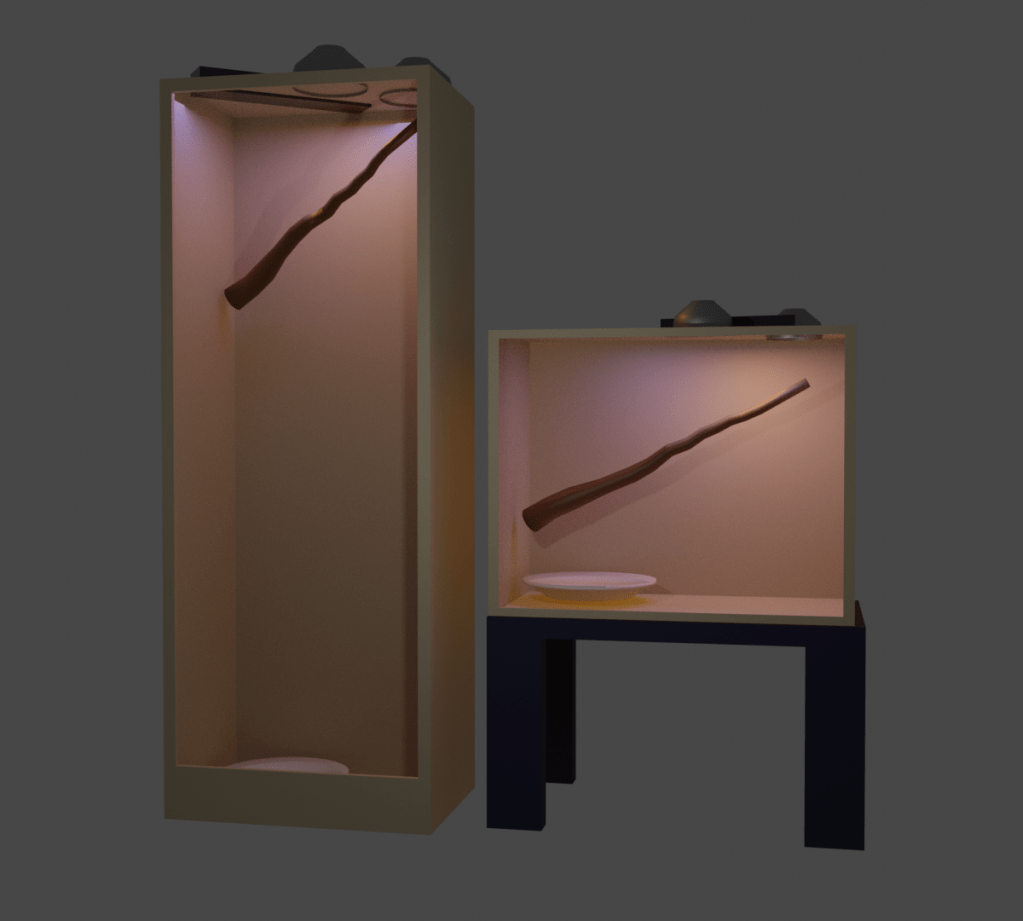
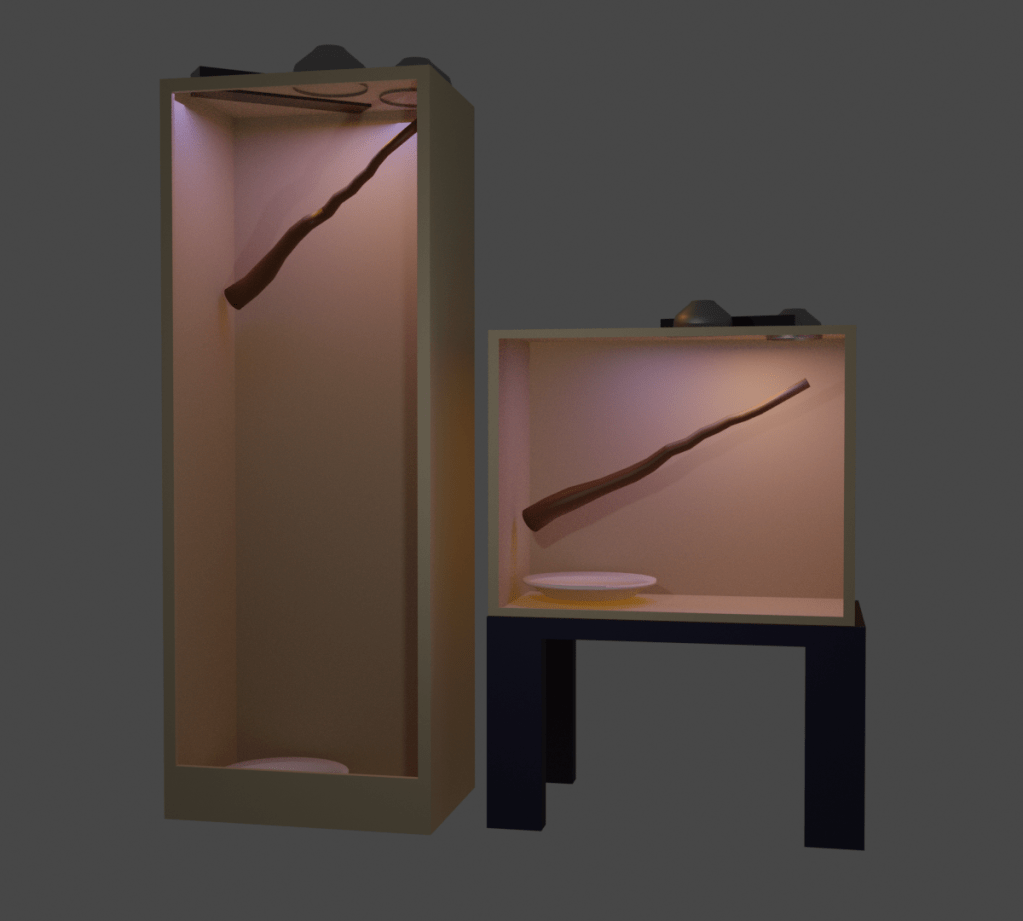
But take a minute and consider how the tall cage design functions for the animal. As an example, lets use a tall cage thats, let’s say, 6 feet tall by 3 foot wide and 2 foot deep. We place a couple halogens on top along with the UV and a bright LED. How far does that useful radiation penetrate into the cage? The light and heat and UV may be too intense at the very top of the cage, so 6 to 8 inches down we start to get into a usable area. But another 18 or 24 or 36 inches down and we loose those optimal temps, and light and UV.
The other important point is that because we have created a tall cage with less depth and breadth we have less room for gradients at the top of the cage. Our basking lamp will cover nearly all the top of he cage, as will our UV and visible light sources. In order for the animal to choose gradients they are forced to move down in the cage – something that they may be reluctant to do simply because the height provides the sense of security they need – and may be an over-riding factor.
If we do the math, our great big tall cage is providing 9, or 12, or 18 cubic feet of usable space. Compare that to the 4x4x4 cage that provides 64 cubic feet of space. Thats over 5 times the usable space of our middle example!
Now I have seen all sorts of work arounds to this design dilemma. And a few of them have been reasonable, if not elegant. Most involve adding additional heat or light to lower levels in the cage. But these kludgey fixes are completely unnecessary.
Rather than ask how we can make tall cages work, lets ask why we thin we need them.
It’s easy to assume that an arboreal lizard or snake or frog needs a tall cage. That somehow having a longer distance from the top of their cage to the bottom is psychologically or behaviorally important. Or that the act of moving way up from a point way down is somehow beneficial. I would argue that it is not. At least not as important as the benefits we get from a cage that provides more usable space, i.e. a cage that is closer to a square.
It is true that some arboreal animals seem to be calmer when they are at the keepers eye level or above. This makes sense because in nature they use height to escape predators. But simply placing the cage on a shelf or stand will provide for this need. Remember, we dont want to advocate for a shallow cage for arboreal species, just not an overly tall one.
So lets see what happens when we build a cage that is 4 foot wide and 3 foot deep and 3 foot tall. Lets say our radiation is on the top of the cage rather than in it, which is a better design for most purposes. The heat, light and UV now reach to the floor of the cage and can be adjusted either by dimmers or by swapping out for different wattage bulbs to achieve that lower temp preference.
We have created horizontal gradients of all the various radiations with this design. The animal not only has much more usable space, but can easily move closer or further away from those sources without loosing the height that gives it an important sense of security.
With just this simple redesign we have increased the usable space for our arboreal pet many fold.
 Herpetoculture Inc
Leave a comment